A Magical Dining Experience – Gracie’s Star Chef Series with Evan Mallett

In the words of Jean Anthelme Brillat-Savarin, the noted and oft-quoted French epicure and gastronome of the late 18th century, “The pleasure of the table belongs to all ages, to all conditions, to all countries, and to all areas; it mingles with all other pleasures, and remains at last to console us for their departure.” Never were truer words spoken, especially as I reminisce about my most recent visit to Gracie’s in Providence (http://graciesprovidence.com).

I was a truly fortunate attendee of Gracie’s latest Star Chef Dinner on April 16th, featuring Evan Mallett of the Black Trumpet Bistro in Portsmouth, NH (http://www.blacktrumpetbistro.com/). From the press release for the event:

A Boston native who has cooked all over the world, Mallett was named in 2011 as a James Beard semi-finalist for Best Chef Northeast. He is well respected in the culinary industry for his dedication to sustainable farming and is active with and sits on the boards of Chef’s Collaborative, Slow Food Seacoast and the Heirloom Harvest Project – an initiative to join farmers, chefs and educators to identify and restore a food system native to the greater N.H. Seacoast.

Chef Mallett is passionate about the use of locally sourced food in his creations, which is the overarching philosophy of Gracie’s Executive Chef, Matthew Varga. As you might imagine, their collaboration was a “fanciful locavore extravagance!”
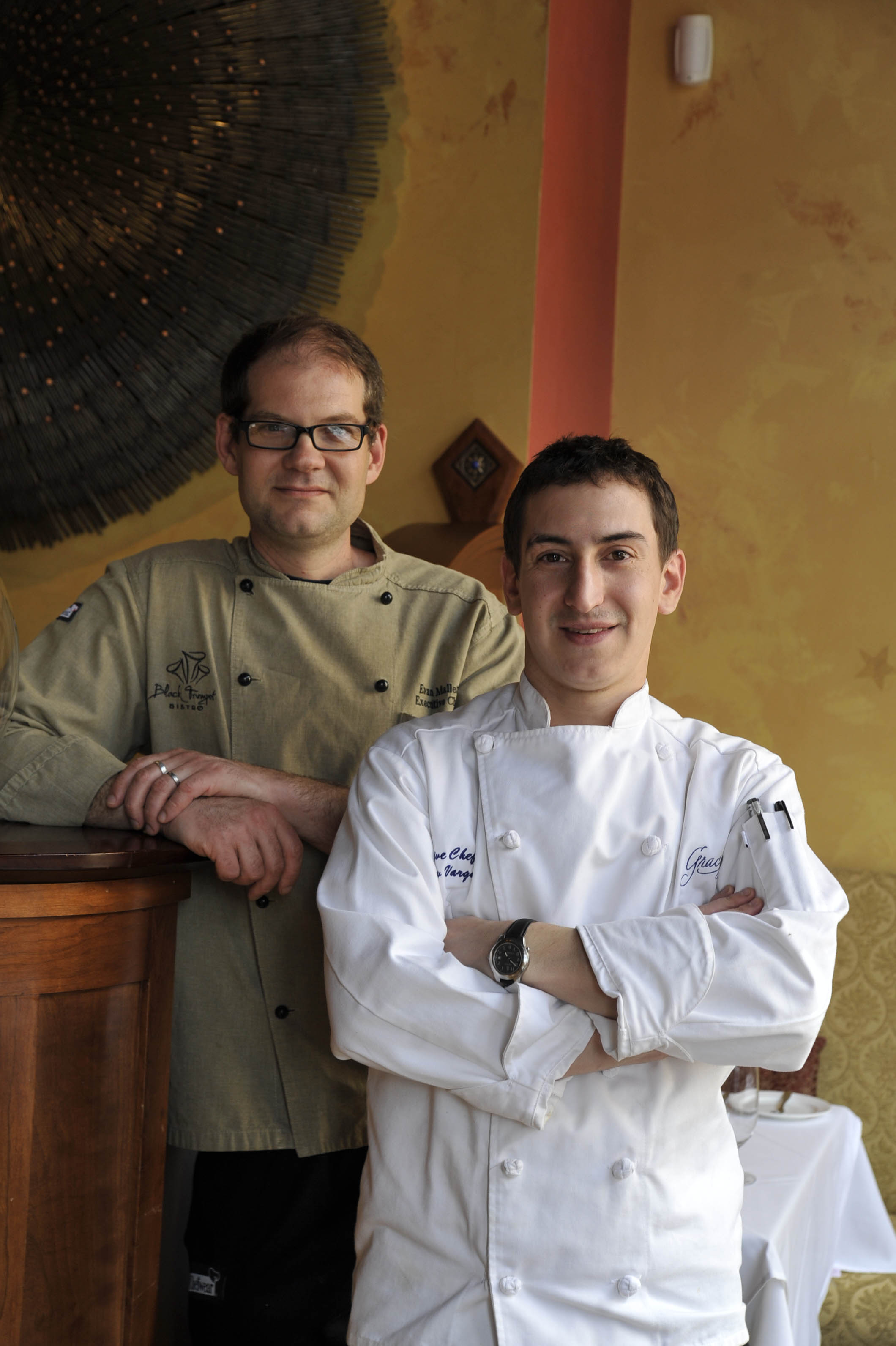
Chef’s Mallett and Varga courtesy of Ron Manville

To start the event, a series of passed canapés were served alongside an interesting sparkling Lambrusco Reggiano, the 2010 Medici Ermente Concerto.

  • Kibbeh Crusted Scotch Quail Eggs with Za’Atar Gribiche

A delightful paean to traditional Middle Eastern cuisine, featuring Kibbeh made from Archer Beef in Maine, accompanied with an emulsion of capers, cornichons, sumac, thyme, toasted sesame and oregano.

  • Whipped Lardo Artichoke Mostarda on Toasted Bread

A whimsical delight featuring the house made Lardo in a frozen and then spun mousse, whose buttery richness is balanced perfectly by the spicy acidity of house made artichoke mostarda, all perched on sliced baguette.

  • Skate & Shad Roe Galantine with Bacon Mayo and Lemon Crackling

An elegant combination of roes inlaid within a lush emulsified mousse and dusted with dehydrated, deep fried lemon zest. In a word: Wow!

  • Twice Baked Eggplant Markeb with Micro-Cilantro

Another tribute to Middle Eastern cuisine, this Markeb, or “ferry boat” in Turkish marries a host of ingredients, including roasted peppers, harisa, tomato, ginger, pine nuts, mint, parsley and honey into a lushly complex treat.

Quartet of Canapes courtesy of Ron Manville

The meal itself consisted of five courses, each one the unique result of the culinary collaboration between Chefs Mallett and Varga and served with a special wine pairing provided by The Savory Grape Wine Shop.

Our epicurean adventure began with Peekytoe Crab served with Champagne Mango and an Avocado-Rhubarb Salsa. The dish was perfectly balanced with the briny, salty flavors of the crab playing gracefully against the sweetness of the mango. The salsa was an interesting blend of buttery, earthy, and spicy flavors that while strong, did not detract from the delicacy of the dish. This was helped by the drizzle of pureed Champagne Mango and rice wine vinegar. The course was accompanied by the 2010 Couly-Dutheil Chinon Blanc, a classically French Loire-based Sauvignon Blanc. With lots of grassy, mineral notes and well-balanced by firm acidity, the wine made a perfect pairing to the dish.

Peekytoe Crab courtesy of Ron Manville

Next we were treated to a truly unique soup: New England Baked Bean Soup with Hot Dog Chips and Cheddar Powder and Crème Fraiche. This dish really emphasized local ingredients, starting with the traditional New England heirloom bean, the Jacob’s Cattle bean as the base of the soup. The beans were pureed with molasses, rendered bacon fat, pork stock, mirepoix, garlic and malt vinegar to create a richly complex, earthy “soup.” Garnish this with a sliced, house made hot dog of ground pork and beef, richly seasoned with coriander and paprika; crème fraiche colored by Amarillo; and cheddar powder, made from the poached rinds of farmhouse cheddars and parmesan wheels, and you have one of the most unique courses this reviewer has ever eaten. The course was accompanied by the 2010 Montinore Willamette Valley Pinot Noir from Oregon, a very Burgundian-style, medium-bodied red wine. With vibrant, earthy red berry notes and moderate tannins and acidity, the wine paired well with the base soup. However the pairing went south when one added the crème fraiche: too much sweetness blunted the fruit in the wine and brought forward the unbalanced acidity.

Baked Bean Soup courtesy of Ron Manville

The adventure continued with a Braised Lamb Belly and Yam Agnolotti with a Coconut Chevre and English Pea-Stou. A simple, yet rich preparation using a confit of lamb belly wrapped delicately in a purse of Okinawa sweet potato pasta, producing a cheeky interplay between the ever so fatty and gamey lamb and the natural sweetness of the yam. Marry this with a whipped concoction of coconut milk and locally-made Chevre from Beltane Farms in Lebanon, CT and a brilliantly green pea-stou, which is a Southern French variation of the Italian Pesto and the experience is simply sublime. The course was accompanied by the 2010 Valpane Barbera del Monferrato, a traditionally-styled medium-bodied red from Italy’s Piedmont region. With earthy and peppery red berry notes, the pairing was perhaps the best of the evening, teasing endless complexity from both the wine and food. Worth noting was the bittersweet chocolate aftertaste that resolved on the palate following a bite of the pasta and a sip of the wine. Magnificent!
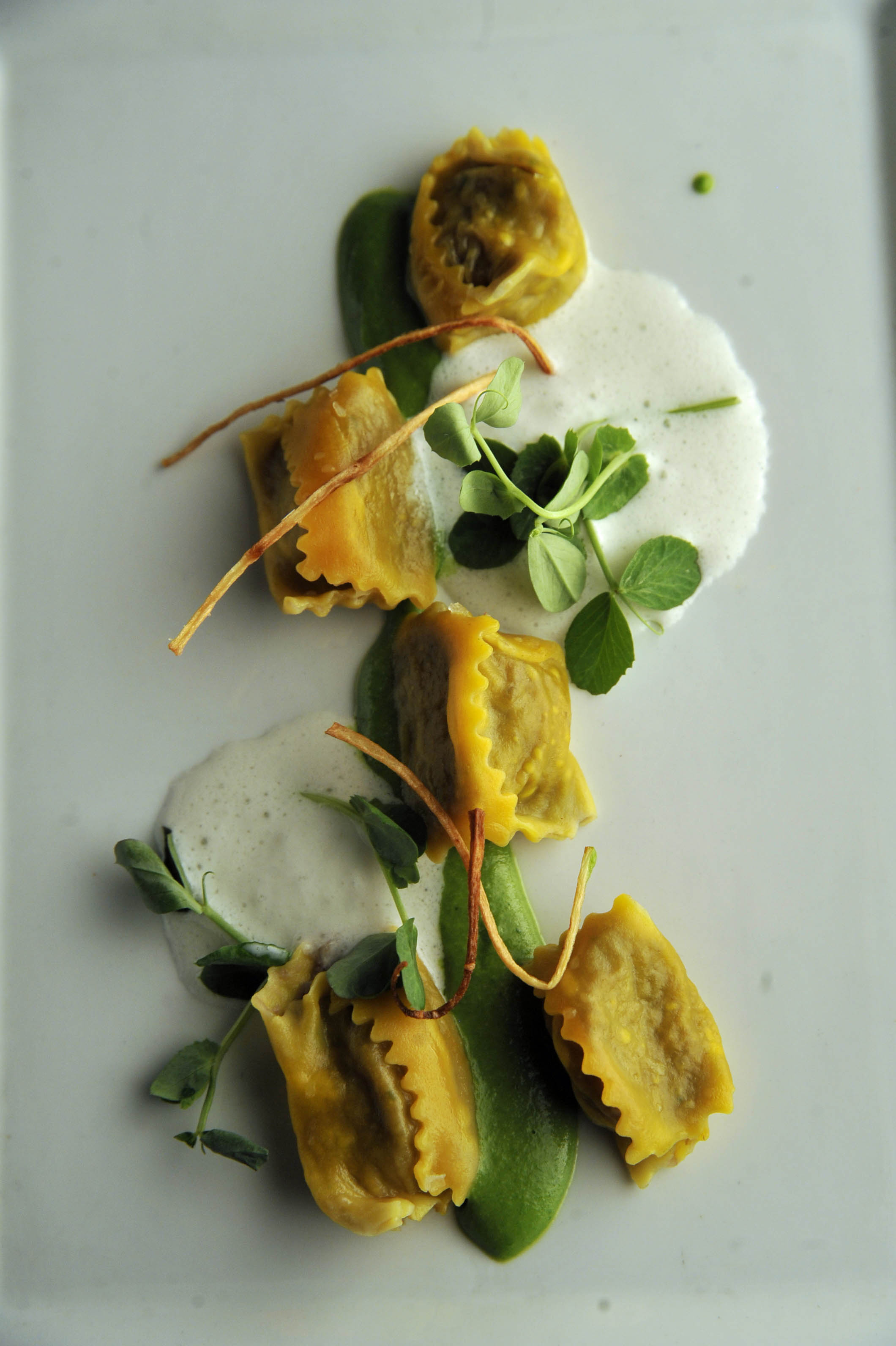
Lamb Aglinoti courtesy of Ron Manville

The intermezzo before the main course was simply magical – Poached Peas in Gin Syrup. The preparation was done by freezing and then pureeing the pea ala Sicilian Granita, with an added essence of mint to liven the spoonful. It was the perfect palate cleanser.

Intermezzo courtesy of Ron Manville

Our main entrée was House Cured Tessa-wrapped Rabbit Tournedoes with Freekeh Risotto, Miner’s Lettuce and Radish Salad. Tessa is considered “lay-flat bacon” cured with fennel, juniper and a host of other savory herbs. Like a Pancetta, the Tessa is shaved and then used to enrobe a combination of the rabbit loin and pounded leg meat. The slow roasting of the meat ensures that the savory elements of the Tessa lovingly marinate the young flesh of the rabbit, which showed incredible depth of flavor. Freekeh, wheat that is harvested and threshed when still green added an earthy element to the creamy Risotto. The course was accompanied by the 2008 Tre Monti Petrigone Sangiovese di Romagna, a classic Tuscan red with earthy, leathery sour cherry notes. With an intense dark core of fruit and cocoa and tar on the finish, the wine paired well with the herbaceous qualities of the rabbit. However, when the rabbit reduction sauce was introduced into the mix, the pairing did not work as well, suffering from the same issue as the soup: too much sweetness blunted the fruit, leaving only sharpness and acidity on the palate.

Rabbit Tournedoes courtesy of Ron Manville

We concluded our meal with a Turkish Coffee Cake with Maple Buttercream, Fernet Gelato and Candied Anise and Hyssop Leaves. The cake was a génoise-style, brushed with coffee, orange and Raki (Turkish Marc), which was delicate and lightly flavored – a perfect ending to such a lush meal. The Gelato was made with the well-known Italian Amaro, or digestif Fernet Branca, but the flavoring was almost undetectable. The sauce was made with crème anglaise, sevilla oranges and African bush tea, which added vibrancy to the finish. The course was accompanied by the 2008 Tre Monti Casa Lola Albana di Romagna Passito, wonderfully honeyed charmer from Italy’s Emilia Romagna region. With hints of orange blossom and quinine, the wine made the perfect pairing with the subtle sweetness and orange elements of the dessert.

Turkish Coffee Cake courtesy of Ron Manville

The meal was magnificent and the culinary creativity displayed by Chefs Mallett and Varga was remarkable. The emphasis on local ingredients combined with the subtle influences of Middle Eastern, French and Italian cuisine made for an exotic gastronomic journey. As usual, the service matched the cuisine with smart, professional attention.

The Star Chef Dinners are events not to be missed, so make sure you get onto Gracie’s email list to get early notification of the next sumptuous meal!
 

2010 Ramón Bilbao Valiñas Albariño, Rias Baixas, Spain

I think it was fifteen years ago that I first tasted Rias Baixas Albariño and I am as taken with the wine today as I was fifteen years ago. Most folks are familiar with the Martin Codax Burgans, or the Paso Señorans bottling – both perennial favorites around our house. So how does one improve on such a simple little quaffer? Drop the price by a few bucks and amp up all the wonderful attributes of Albariño: beautiful, perfumed nose, refreshing palate with a crisp clean finish.

Such is the Valiñas from Ramón Bilbao, a stunning little wine from the northwest of Spain that, after a healthy discount is just a hair over $10! If you are looking for the perfect summer wine, look no further!

My tasting note:

Lively, fresh nose with tropical fruit and floral hints – lovely, perfumed scent. Light-bodied with firm acidity – well balanced. Racy with citrus and tropical fruit notes and a touch of mineral and chalk. Short, clean finish – smooth, clean and refreshing. Not for aging, although with the screw cap, the wine should hold up well. Great value!

Cheers!

April 2012 Wine Tasting Events

We are pleased to continue our 2012 wine tasting season with two fun and exciting events in April…

April 14, 2012 – The Art of Cocktail – The Bitter End @ 3:00pm

Cost: $50 per person

Location: Wrentham, Massachusetts

Installment number three of our very popular Art of the Cocktail series. This edition builds on the classic definition of the cocktail: “a stimulating liquor composed of spirits of any kind, sugar, water, and bitters-it is vulgarly called a bittered sling and is supposed to be an excellent electioneering potion, inasmuch as it renders the heart stout and bold, at the same time that it fuddles the head. It is said, also to be of great use to a democratic candidate: because a person, having swallowed a glass of it, is ready to swallow any thing else.” In this class we will closely examine the effect of bitters on several potent libations. Heavy appetizers will be served to help temper the impact of the spirits.

And…

April 28, 2012 – Smart Wine Shopping @ 2:00pm

Cost: $50 per person

Location: Brighton, Massachusetts

One of the biggest questions that I get at my wine classes is: How do you shop for wine? Wine shopping is really about relationship building. While you can spend a lot of time scurrying around town looking for the best wine at the best price, your time will be better spent cultivating a rapport at a few local wine shops. Getting to know the owners, or knowledgeable sales staff at a local wine shop, or more importantly getting them to know more about your own tastes and interests will ultimately lead to a more enriching shopping experience. At this event, hosted in the back room of Martignetti’s Fine Wine in Brighton, Wine Director George Bardis will help me lead the group through a selection of fun, high-value wines, including the usual artisanal cheese and bread, culminating in a guided shopping tour of the store.

Contact: paul_malagrifa@musingsonthevine.com to reserve your seats today!

A Night of Splendor… Gracie’s in Providence

Several years ago we came across Gracie’s in Providence (http://graciesprovidence.com), a terrific foodie destination if there ever was one. We were staying at one of our favorite haunts, the Historic Jacob Hill Inn in Seekonk (http://www.inn-providence-ri.com) and we were looking for a special place to celebrate our Anniversary, so off to Gracie’s we went. It has been a wonderful love affair ever since – between us, with The Jacob Hill Inn and with Gracie’s!

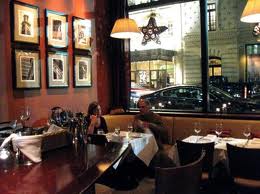
 (Our table at Gracie’s!)

We recently returned to jointly celebrate a few birthdays and we were greeted with a wonderful table setting, sprinkled with tiny celebratory stars and toasted with a complimentary taste of the Poema Cava and an amuse bouche of puréed butternut squash, white raisins steeped in honey all dusted with candied pecans – a heavenly way to start the night.

Gracie’s offers a traditional prix fixe menu, as well as a series of three-, five- and seven-course tasting menus. The tasting menus can be combined with wine pairings, if desired. We opted for the seven-course tasting menu, with wine pairings, a truly decadent gustatory pleasure.

First off, we enjoyed the 2009 Pacific Rim Riesling from the Columbia Valley paired with an artichoke barigoule accompanied by house made lardo, sugar snap peas and French breakfast radish drizzled with a lemon sabayon. Surprisingly, the pairing worked well, despite artichokes being among the “difficult to pair” foods. The sabayon picked up the citrus in the wine and carried through the dish really well.

Next up we enjoyed the 2010 Jonathan Edwards Estate Grown Cabernet Franc from Connecticut paired with handmade russet potato gnocchi with braised oxtail, foraged mushrooms, celeriac puree, and a three-year old provolone. The gnocchi were delightfully light foils to the rich intense sauce. Pairing-wise, the high acidity of the Cabernet Franc cut the richness of the dish nicely, but the wine was too light-bodied for the complexity of flavors.

For the third course we enjoyed the 2009 Domaine de Fenouille Muscat Beaume de Venise paired with sautéed Hudson Valley foie gras and brioche, hazelnut butter, Muscat grapes and red currant jam. For me, this was the course of the evening! The foie gras was rich and creamy and the pairing with the Muscat BdV was sheer bliss.

Fourth up, we enjoyed the 2010 Bichot Chablis paired with a brown butter seared Chatham cod loin with roasted baby carrot and turnips, puréed parsnip, pickled red pearl onion, black pepper cavatelli, marconi almonds and drizzled with parsley oil. The cod was moist and flaky and the mélange of accompaniments provided a pleasing contrast between the earthy root vegetables and the slightly tangy onion and black pepper. The pairing of the Chablis worked very well, cutting the buttery sauce, leaving the palate refreshed.

A dollop of house made key lime sorbet offered further palate cleansing in preparation for the fifth course, braised pork belly with cider braised mustard greens, hon-shimeji mushrooms, caramelized cipollini onion, crispy onion rings, pork cracklings and smoked red tomato jam paired with the 2009 Kermit Lynch Côtes du Rhone. This course was a close second to the foie gras! The richness of the pork belly was balanced perfectly by the vinegary, slightly bitter mustard greens, a la North Carolina BBQ. The earthy mushrooms with the sweetness of the onions lent weight and an uplift to the finish. Pairing-wise, the CDR worked, but the vinegary mustard greens challenged the fresh, fruity palate of the wine somewhat unfavorably.

The sixth course was a cheese plate of three domestic artisanal delights, paired with Ferreira White Port. Leading the way was a Vermont Bijou, a creamy “jewel-like” goat cheese that was served with a drizzle of apple butter. Next on the plate was another Vermont offering from Twig Farm, their raw goat’s milk Tomme, served with more of the smoked red tomato jam. The last cheese was very local; Great Hill Blue from Marion, MA served with another local product, Aquidneck honeycomb and candied pecans. The wine worked very well against the Bijou and the Tomme and as long as you left the honeycomb alone, the Blue worked as well. Unfortunately, the incredible sweetness of the honeycomb, while soothing against the blue cheese, rendered the wine into unpleasant acidity.

The final course, dessert, was a lovely jasmine pound cake, drizzled with honey meringue, coconut-ginger-blood orange soup and black tea ice cream paired with the 2008 Terre Rouge Muscat-à-Petits Grains from the Shenandoah Valley in California. Light and delicate, this final course was the perfect way to finish such a gustatory masterpiece.

To us, a meal is not perfect unless the service matches the food and at Gracie’s, the wait staff is up to the challenge. Lydia and John, our primary servers took supremely wonderful care to make this evening ideal. Their blend of friendly, courteous and attentive service made us feel welcome and at home for the nearly three hour sojourn.

I can guarantee that if you enjoy food and wine – not just eating, but really delving into the tiny details and subtle nuance resulting from the time consuming process that is fine cuisine, you will be smitten by Gracie’s. The key is: opt for one of the tasting menus, with wine and do not rush!

Don’t cry for me, Argentina…

I tend not to follow wine fads… They burn out relatively quickly and frankly do more harm than good. A current fad that seems to be running its course is Argentine Malbec… but first a bit about Argentina…

Argentina is considered the most important Latin American wine producing country, with the largest amount of land under vine (209,000 Hectares, or 504,000 Acres) and the largest per capita consumption rate for wine (40.99 Liters, or 10.8 Gallons).

Annual wine production had been as high as 27 Million Hectoliters or 713 Million Gallons in 1973, but has since fallen to 12.5 Million Hectoliters or 331 Million Gallons in 2000, ranking Argentina as the 5th most productive wine region in the world.

Argentina has a wide range of climates, mostly temperate due to the broad extent and varying elevations of the vineyards. Water is plentiful, land is cheap and there is a potential market of 35 Million residents who are of European heritage with an in-grained culture of wine drinking. So, why isn’t Argentina’s wine industry stronger? Simply put a lack of economic stability. With rampant inflation, the devaluation of the Peso and the recent change (1991) to an open market government, the wine industry has largely focused on producing large volumes of mediocre table wines.

This is slowly changing, which is evident from the increase in foreign investment and the increased availability of finer, Argentine wines.

Some History

The history of the Argentine wine industry begins with its colonization by the Spanish:

  • 1536 – Buenos Aires is founded by Pedro de Mendoza, but native Indians drive the Spaniards out.
  • 1553 – Santiago is founded by Spanish settlers arriving from Peru and Bolivia and the settlement begins to thrive.
  • 1561 – Mendoza is founded by Spanish settlers arriving from Chile.

In each case, missionaries accompanied the settlers, bringing God and the vine to Argentina. These initial plantings were likely the Criolla grape, which made only mediocre sacramental wines. Over time, plantings grew to include the more familiar European varieties.

The evolution of the Argentine wine industry was largely due to three factors:

  • Ever-growing immigrant population accustomed to drinking wine (Europeans).
  • Domingo Faustino Sarmiento, Argentine President (1868-74), responsible to establishing wine schools throughout Argentina, including noted French and Italian wine experts.
  • The Pacifíco Railway (1885) that connected Mendoza with Buenos Aires, which opened the country to trade.

The wine industry continued to grow throughout the 20th Century, peaking in 1976, largely due to exportation of cheap wine to Chile. It was at this time that Argentina was recognized as a country with “great wine-making potential” in the press. This led to Argentine wine makers actively and aggressively pursuing the export markets of Britain and America. The strategy met with success and exports shifted from cheaper, table wines intended for Chile, to finer wines destined for Europe and America. Production ramped-up to meet demand and it appeared as if Argentina was transforming into a true fine wine producer.

However, all of this success was destroyed by the invasion of the Falkland Islands in 1982. Overnight, the lucrative export markets outside of Latin America were gone and the wine being produced was too expensive for the cheap, Chilean market, which resulted in vast overproduction that led the industry to crash.

Upon cessation of hostilities Argentina set about rebuilding their wine industry. Over the following ten years the wine industry began to revive, fueled in large part to the regime change in Buenos Aires (1991). In the last ten years, the availability of hard currency, more foreign investment and the re-establishment of an export market for fine wines have allowed Argentina to build a strong, fine wine industry with even greater growth potential in the future.

Regions

The Instituto Nacional de Vitivinicultura (I.N.V) is responsible for organizing and administering the regions and wine laws of Argentina. The INV has established four basic regions in Argentina:

  • North-West
  • Centre-West
  • South
  • Other

The INV has also established an appellation system, like those of Europe, called the Denominación de Origen Controlada of DOC. The first appearance of the DOC on an Argentine wine label was 1992 (San Rafael). There are two regions officially recognized as DOC regions: San Raphael and Luján de Cuyo. Most old time producers do not believe in the DOC system, largely due to years of governmental distrust. More modern producers do not believe in the DOC system because they do not want to be “handcuffed” to antiquated rules like their European counterparts. The fact that the DOC is largely overlooked by the wine makers means that most labels are without any kind of DOC specified and the likelihood of more classifications is doubtful.

Despite the lack of a generally-accepted DOC system, there are many regions that are noted for fine wine production.


North-West

Salta Province

Production

Acreage/Elevation

White Wine

Red Wine


1%

1,500ha/2,000m

80% – Torrontes

20% – Cabernet


Cantamarca Province


1%

400ha/2.000m


100% – Pinot Noir


LaRioja Province


5%

5,300ha/935m

80% – Torrontes

20% – Cabernet


Centre-West (Cuyo)


San Juan Province


31%

21,000ha/630m

85% -Muscat

15% – Bonarda


Mendoza (Overall)


61%

72,000ha/1,300m


North Mendoza


Las Heras

Lavalle


El Borbollón

Los Coralitos


El Plumerillo

Costa de Araujo


Nueva California


Upper Mendoza River


Godoy Cruz

Guaymallén

Luján de Cuyo

Maipú


Agrélo

Coquimbito


Carrodilla

Russell


Drummond

Cruz de Piedra


Las Compuertas

Lunlunta


Perdriel

Las Barrancas


Portrerillas


Ugarteche


Vistalba


East Mendoza


San Martin

Junín

Rivadavia

Santa Rosa

La Paz


Medrano

Palmira

Las Catitas

AltoSalvador


Las Chimbas


Uco Valley


Tupungato

Tunuyán

San Carlos


La Arboleda

Villa Seca

El Cepillo


Aguas Amargas

VistaFlores

Chilecito


Las Rosas


Los Sauces


South Mendoza


San Rafael

General Alvear


Las Paredes

Carmensa


Cuadro Benegas


El Cerrito


La Llave


Goudge


Rama Caida


Cañada Seca


Las Malvinas


Jaime Prats


Villa Atuel


South


Patagonia –Rio Negro Province


1%

5,400ha/300m

10% – Sauvignon

90% – Malbec


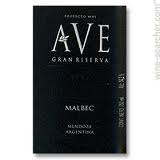
 Today, the craze is all about Malbec from Argentina – below are two from the same winery, AVE that I found noteworthy.

My tasting notes for the wines:

2009 AVE Malbec, Mendoza – $13.99 per bottle

Dark fruit nose with black cherry, menthol, briarwood and cedar hints. Full-bodied with moderate acidity and firm, well-integrated tannin – good balance. Black fruit core with herbaceous and cherry notes. Moderate length, smooth with dried fruit and vanilla on the aftertaste. Drinking well now and should hold for another 2 to 3 years in bottle. Good value!


2008 AVE Malbec Gran Reserva, Mendoza – $22.99 per bottle

Intense, rich nose with black cherry, anise menthol and cedar hints. Full-bodied with moderate acidity and firm, dry tannin – well balanced. Black cherry on the palate with vanilla, cedar and tar notes. Long finish, smooth with a nice allspice and dried fruit aftertaste. Drinking well and should benefit from another 5 to 7 years in the bottle.

Cheers!

A few from España…

It’s been a while since I’ve posted… We’ve been tasting a lot, just bogged down with a whole host of other stuff… Well, we’re back, so here goes…

Spain is one of my favorite wine producing countries – great diversity of style and flavor, very high quality standards and fantastic values abound! For the last 20 years I have sung the song of praise for Spain and many of my friends have appreciated that.

I recently picked-up two wonderful little wines from arguably the most well-known region in Spain – Rioja. Located in the Ebro valley in northern Spain, the region is divided into three sub-regions: Rioja Alta, Rioja Baja and Rioja Alavesa, each with its own terrior that lends diversity of character to the blend. Rioja is one of the oldest wine making regions in Spain, officially recognized by the King of Navarre in 1102 AD.

The region is known primarily for its red wines, which make up approximately 85% of production and are largely produced from the Tempranillo grape. Other red grapes can be found in the blend, such as Graciano and Mazuelo. Rosado wines are also produced, as well as whites, the latter being a product of the Viura grape, known elsewhere in Spain as Macabeo. The style of classic, or traditional Rioja is very distinctive, often times possessing a rustic, yet elegant flavor profile, tinged with vanilla and cedar notes. The vanilla and cedar notes come from the American oak cooperage winemakers use in the aging process of the wine.

Rioja is one of two regions that holds the highest honor in the Spanish wine hierarchy – Denominación de Origen Calificada, the other being Priorato. Within this hierarchy, Rioja is categorized as thus:


Time in Cask

Total Time Aged


Red

White

Red

White

Vino Joven

None

None

1-year after vintage date

Crianza

6 months

6 months

24 months

12 months

Reserva

12 months

6 months

36 months

24 months

Gran Reserva

24 months

6 months

60 months

48 months

 The first wine is a Rioja Blanco from a very well-known, high-quality producer – Bodegas Muga. The Muga wine is barrel fermented and aged in oak to produce a smooth, creamy wine with elegant structure, but the application of wood is light-handed so the lively fruit persists on the palate. According to their web site: “Bodegas Muga is located in the historical Barrio de La Estación (railway station district) in Haro. The facilities (270,000 square foot) are two centuries old, built mainly of stone and oak. In fact, oak is paramount in the winery. There are 200 oak deposits as well as 14,000 barrels, made out of different types of oak ranging from French oak (Allier, Tronçais or Jupilles), American, Hungarian, Russian and even the small consignment of Spanish oak.”

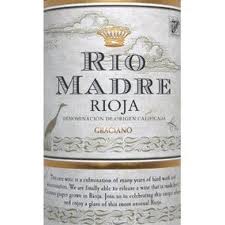
The second wine is a Rioja Crianza from Rio Madre with the distinction of being made from 100% Graciano grapes. The wine is powerful with great structure and wonderful complexity. Rio Madre is a relatively young winery located in the Rioja Baja and growing Graciano on 60+ year-old vines. Jorge Ordonez, the world renowned wine maker is a consultant to the operation, which could account for the unbelievable intensity of the wine.

My tasting notes for the wines:

2009 Bodegas Muga Rioja Blanco Barrel Fermented – $11.99 per bottle

Lively, creamy nose with vanilla, apple and tropical hints – very pretty. Medium-bodied with firm acidity – refreshing and crisp – good balance. Tart apple and lemon palate with oak and caramel notes. Moderate length – smooth with a pretty honeyed aftertaste. Drinking well – not for aging. Great value!


2010 Rio Madre Rioja – $11.99 per bottle

Earthy nose with deep plum, lavender and briarwood hints. Full-bodied with firm acidity and firm, dry tannin – good balance. Dense, chewy palate with blackberry jam and stewed  fruit notes – Wow! Long finish with a smooth but tight aftertaste. Some spice, cedar and vanilla – very nice. Drinking well and should benefit from another 5 to 7 years in the bottle. Great value!

Cheers!


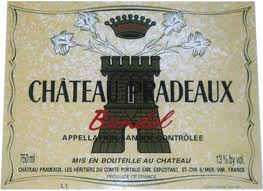
2005 Château Pradeaux, Bandol

Bandol, in the south of France in Provence is a sun-drenched wine region along the Mediterranean Sea known for making powerful red and lively rosé wines. The overall region has a long-standing viticultural tradition going back almost 2,600 years, largely started by colonizing Greek settlers and significantly bolstered by each successive wave of settling peoples. Proximity to the port of Marseille has meant that the region has benefited from access to historical, global trade routes, which has placed Provencal wines and the wines of Bandol on tables across the globe.

The principle grape variety of Bandol is Mourvèdre, which must make up at least 50% of the blend in AOC wines. Other allowable grapes are Syrah, Carignan, Grenache and Cinsault, although most of the best producers lean very heavily on Mourvèdre. Stylistically, the red wines are often massively tannic with long aging potential. Both dry and sweet red wines are produced. The rosé wines are light and perfumed, ready for enjoying on a sunny patio with lighter fare. A small percentage of white wine is produced, primarily from Clairette, Bourboulenc and Ugni Blanc, but it almost never gets out of the region. The soil in the vineyards is primarily limestone, sand and silica, which are ideal for growing Mourvèdre.

Château Pradeaux a well-regarded estate owned by the Portalis family since the 18th century, has a reputation for seriously structured, often powerfully tannic wines made almost exclusively from Mourvèdre. The wines are aged in large old casks and are released as much as four years after the harvest. Successive bottle aging is the key to releasing the complexity of these wines, but be prepared to wait a while because the wines unfold very slowly.

The 2005 is the current offering from Pradeaux and it will be a while before the wine is at its full potential. At an average retail price of almost $50 per bottle, it is not cheap, but it is a very special wine with tremendous potential.

My tasting note:

Fresh, lively nose with cherry, allspice and light floral hints. Full-bodied with moderate acidity and firm, tough tannin – good balance. Tight, unyielding palate with sour cherry, tobacco leaf, dried herb and tar. Moderate length – closed with traces of spice and cedar. Needs time – not for the faint of heart.

Cheers!

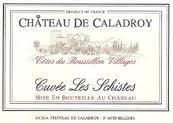
2009 Château de Caladroy “Cuvée Les Schistes,” Côtes de Roussillon Villages

The Côtes du Roussillon is one of France’s sunniest and warmest wine growing regions, with a climate and history that has more in common with Spain, its neighbor to the west, than its French cousin, the Languedoc to the east. The sub-region Côtes du Roussillon Villages is bestowed upon twenty-five villages to the south of Corbières, along the Agly River.

Principle red grapes are Carignan, along with Cinsault, Grenache and Mourvèdre – only red wines are allowed to be made in Côtes du Roussillon Village, with Rosé and White wines allowed elsewhere in the appellation. Principle white grapes are Macabeu and Malvosie and produce wines that are a perfect match with seafood and shellfish.

Château de Caladroy is a well-known producer in the region, with several bottling. The Cuvée Les Schistes represents their entry-level wine and at an average per bottle price of $18.99, before the discount, the wine is good value in a superb vintage.

From the Vintage 59 web site:

In its heyday, Château de Caladroy was a small outpost high in the arid hills behind Perpignan. It had its own school, workers’ quarters, stables, an elegant 19th century chapel, a manor house and other dwellings, and an ancient fortress dating from the 12th century—for Caladroy was once a fortress on the ancient Kingdom of Majorca’s frontier. All of this is perched on a knoll; below, on a broad saddle of a ridge, grow the vineyards.

Although the school no longer functions and the workers’ quarters lie empty except at harvest, the chateau and its surroundings are striking. You drive up from Perpignan, a city which has a whole lot more in common with Barcelona than it does with Paris, and climb winding roads into the hills where the sparsely populated land is rocky and covered with scrub hardwoods and the ever present garrigue. At the top of the last rise, the road turns onto the saddle of vineyards; at the far end, beyond a windbreak of cedars, rises the Caladroy knoll with white buildings and red clay-tiled roofs. Looming in the distance are the snow-capped Pyrenees.

This is Roussillon, the sunniest viticultural area in France, forever battered by a dry wind that sweeps off the high Pyrenees known as the tramontane. Fully exposed at over 1,000 feet above the nearby Mediterranean, Caladroy and its vineyards occupy the top of the Fenouillèdes hills, isolated between two river valleys. This altitude gives Caladroy’s wines a certain measure of finesse that nicely balances their darkly concentrated flavors.

Today the vineyards have been extensively replanted, with Grenache, Syrah, and Mourvèdre dominating. Yields here average 25hl/ha, far below the permissible 45hl/he granted the top “Côte du Roussillon-Villages” AC designation. Moreover, the cellar was completely revamped in 2001, enabling cellarmaster Jean-Philippe Agen to make some super wine.

My tasting note:

Earthy nose with black cherry, menthol and briarwood hints – classic southern France. Medium-to-full-bodied with moderate acidity and firm, dry tannin – good balance. Dark fruit core with black cherry, rose attar and tarry notes. Long finish – smooth with  dark chocolate and cocoa dust. Lovely. Drinking well now and should improve with another 3 to 5 year in bottle.

Cheers!

2008 Principe Corsini Birillo di Marsiliana, Maremma Toscana IGT

Maremma, a fertile agricultural area located in the southwestern part of the larger region known as Tuscany, is a very popular vacation destination. Its popularity is due in part to the nearly untouched beauty of the landscape, combined with impeccable cuisine and an up-and-coming number of quality wineries.

Principe Corsini has a long-standing history in the Maremma, going back to the 17th and 18th Centuries. However, the Corsini were not known for their winemaking until Duccio Corsini began cultivating grapes on 10 hectares (24.3 acres) of land near the family estate, Marsiliana. Over the years, production grew and winemaking became a Corsini hallmark.

The Birillo is a classic Bordeaux-blend of 60% Cabernet Sauvignon and 40% Merlot, grown on sandy silt on clay. The average age of the vines is 13 years and the resultant wine spends 12 months in re-used oak barrels. Production yields approximately 86,000 bottles and at a per bottle price of $18.99, before discount, the wine represents a very good value.

My tasting note:

Earthy, rustic nose with dark cherry, anise and briarwood hints. Medium-to-full-bodied with moderate acidity and smooth, supple tannin – good balance. Sour cherry, cedar and saddle leather notes. Moderate length with a smooth, spicy finish. Drinking well now and should hold for another 2 to 3 years in bottle. Good value!

Cheers!

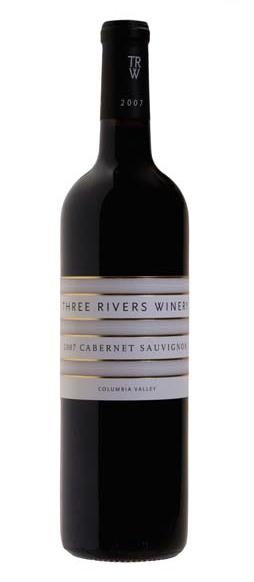
2007 Three Rivers Winery Cabernet Sauvignon

I can safely say that I don’t drink enough wine from Washington State. I don’t know why I don’t drink more, but I should, largely because everytime I open a bottle, I am pleasantly reminded of just how good these Pacific Northwest wines really are. Last year I conducted a class on North American wines and after the class, I wished we had tasted more of the wines from WA. Even after 19 wines…

I recently tasted a great Cabernet Sauvignon from the Columbia Valley that is just stunning – The 2007 Three Rivers Winery Cabernet Sauvignon – Wow! Like, move over California kind of wow… The wine is not cheap, with an average bottle price of $22.99, but the wine does represent a good value. With plenty of tannin and a nice core of intense, dark fruit, this wine has great aging potential and yet possesses enough elegance and grace to be drunk now with a nice thick cut New York strip.

After my tasting note below, I’ve included a little piece about the wines from Washington State, so be sure to read on…

My tasting note:

Jammy nose with plum, black cherry, menthol and saddle hints. Full-bodied with moderate acidity and firm, dry tannin – well balanced. Tight palate with an intense core of black fruit flavors – sour cherry, tobacco, anise and vanilla notes. Moderate length with a nicely layered and evolving finish. Drinking well now and should continue to improve with another 5 to 7 years in the bottle. Charming and elegant. A solid value!

History – Washington State Wines

Washington’s first wine grapes were planted at Fort Vancouver by the Hudson’s Bay Company in 1825. By 1910, wine grapes were growing in many areas of the state, following the path of early French, German and Italian settlers. Hybrid varieties arrived in nurseries in the Puget Sound region as early as 1854, and by 1860 wine grapes were planted in theWalla Walla Valley.

Large-scale irrigation, fueled by runoff from the melting snowcaps of the Cascade Mountains, began in eastern Washingtonin 1903, unlocking the dormant potential of the rich volcanic soils and sunny, arid climate. Noble varietals were planted in the Yakima and Columbia Valleys and wine grape acreage expanded rapidly in the early part of the 20th century. The arrival of Prohibition in 1920 put a damper on wine grape production, but ironically may have helped spawn early interest in home winemaking. At the end of Prohibition the first bonded winery in the Northwest was founded on Puget Sound’s Stretch Island. By 1938 there were 42 wineries located throughout Washington State.

The first commercial-scale plantings in Washington State began in the 1960s. The efforts of the earliest producers, predecessors to today’s Columbia Winery and Chateau Ste. Michelle, attracted the attention of wine historian Leon Adams. Adams in turn introduced pioneering enologist Andre Tchelistcheff to Chateau Ste. Michelle. It was Tchelistcheff who helped guide Chateau Ste. Michelle’s early efforts and mentored modern winemaking in this state. The resulting rapid expansion of the industry in the mid 70s is now rivaled by today’s breakneck pace, where a new winery opens nearly every 15 days. This rapid growth ranks Washington State second nationally for premium wine production and more than 31,000 acres (12,545 hectares) are planted to vinifera grapes.

Significant developments in Washington State include the formation of the Washington Wine Commission, a unified marketing and trade association, in 1987. In 1999, the Commission established the Washington Wine Quality Alliance (WWQA) to spearhead development of industry standards in winemaking and labeling. Washington is the first state in the U.S. to define standards for “reserve” wines.

Important Statistics – Washington State Wine

National rank: 2nd largest premium wine producer in the United States

Number of wineries: 500+

Number of wine grape growers: 350

Appellations: Washington has nine major American Viticultural Areas (AVA)

Yakima Valley – 1983 Red Mountain – 2001
Walla WallaValley – 1984 Columbia Gorge – 2004
Columbia Valley – 1984 Horse Heaven Hills – 2005
Puget Sound-1995 Wahluke Slope – 2006
  Rattlesnake Hills – 2006

Varietals produced: 20+ varietals

Important Red Varieties: Important White Varieties:
Merlot Chardonnay
Cabernet Sauvignon Riesling
Syrah Sauvignon Blanc
Cabernet Franc Semillon
Sangiovese Viognier

 Ratio of red to white: 57% red / 43% white

Wine Production: 18.0 million gallons or 68.3 million liters

Wine Grape Acreage: 30,000+ acres or 12,140+ hectares

Record Harvest: 2005 with 116,760 tons

Estimated retail value (2004 production): $684.9 million

Full-time equivalent wine-related jobs: 14,000