Monthly Archives: March 2013

2010 Bodegas Breca Old Vines Garnacha,Calatayud, Spain

05 Tuesday Mar 2013

Posted by musingsonthevine in Wines

≈ 2 Comments

Here I go again (wasn’t that the name of a Whitesnake song…) touting another charming wine from our friends on the Iberian peninsula – Spain. This one is at a slightly higher price point than the Vega Sindoa, but it delivers a serious punch of raucous fruit and old world terrior.

The claim on the label is that the fruit used in production was “meticulously hand harvested clusters of fully matured Garnacha grapes selected from only the finest hillside vineyards located 3,000 ft. above sea level. These vineyards were first planted in the last decades of the nineteenth and the first decade of the twentieth centuries.” Based on what I could research, the vineyards appear to have been planted between 1924 and 1947, making the vines between 65 and 88 years old. While legally the term “old vines” has no meaning in Spain, arguably these vines would qualify as old. As such yields are very low, about one ton per acre, which is surprising given the price. The vineyards are located on steep, hillside terrain with a mix of slate and gravel soil, obviously contributing to the strong old world character.

breca

The winery was founded in 2005 by Jorge Ordoñez and sits on 650 acres. I’m not sure how a wine of this caliber, with impressive pedigree (low yield, hillside site, old vines) can be produced at such a reasonable price, but I’m glad the Spanish can accomplish such a feat.

Of course Mr. Parker rated this wine a 94, which I was unaware of until I did some research. This will mean that the wine will be gobbled up, so make a bee-line to your favorite shop and buy what you can. In Mr. Parker’s words, this wine “may be the most amazing wine I have ever tasted at this price in over three decades.”

Wow… I’m not sure I can express the same sentiments, but I can tell you this wine is really pretty amazing…

My tasting note:

Ripe, juicy nose with black cherry – jammy, cedary hints. Full-bodied with moderate acidity and firm, dry tannin – good balance. Lush, dense palate – dark fruit core – tarry with black pepper and violet notes. Long finish – smooth and a bit tight. Great structure on the finish. Drinking well and should improve for another 3 to 5 years in bottle.

At an average bottle price of $15.99 before the discount, this wine is a very respectable value.

Cheers!

2009 Château d’Or et de Gueules Les Cimels, Costières de Nîmes

03 Sunday Mar 2013

Posted by musingsonthevine in Wines

≈ Leave a comment

Costières de Nîmes is located in the southernmost part of the Rhône valley and has a very long wine making history going back nearly 2000 years, making it one of the oldest vineyards in Europe. The region was settled by veterans of Julius Caesar’s campaigns in Egypt, and some bottles of Costières de Nîmes bear the symbol of the Roman settlement at Nîmes, a crocodile chained to a palm tree. Local lore speaks of a chart in the kitchen of the Palais des Papes in Avignon, indicating that many of the towns in what is now the Costieres de Nîmes region were the main suppliers of wine to the Popes of that era.

The current region was formerly known as Costières du Gard, designated a VDQS level wine. In 1986 the wine was granted AOC status and was ultimately renamed Costières de Nîmes in 1989. Originally a part of the Languedoc department, in 1998 the local growers’ organization requested that the appellation be attached to the Rhône wine region, largely because the style of the Costières de Nîmes wines are more reflective of the typical characteristics of Rhône valley wines. The transition finally took effect on July 19, 2004.

The soil of the region is mostly a mixture of round pebbles (“galets”) similar to Châteauneuf-du-Pape, with sandy alluvial deposits and red shale throughout. The soil depth from 9 to 45 feet is largely responsible for the variations of style within the AOC. The climate is Mediterranean, similar to that of the Rhône valley, but is influenced strongly by its proximity to the coast and the accompanying sea breezes.

The wines are produced in selected parcels in the following 24 communes: Aubord, Beaucaire, Beauvoisin, Bellegarde, Bernis, Bezouce, Bouillargues, Le Cailar, Caissargues, Garons, Générac, Jonquières-Saint-Vincent, Lédenon, Manduel, Meynes, Milhaud, Nîmes, Redessan, Rodilhan, Saint-Gilles, Sernhac, Uchaud, Vauvert, and Vestric-et-Candiac.

Costières de Nîmes produces mostly red wines (59%), with a blend of Syrah, Mourvèdre, Grenache, Carignan and Cinsault.  White wine production accounts for about 4% of the AOC production and are made from the Bourboulenc, Clairette Blanc, Grenache Blanc, Maccabéo, Rolle, Roussanne and Ugni Blanc varieties. The whites must be blended from a minimum of two of the listed varieties. Rosé wine production accounts for approximately 37% of the total production, made from the same blends of red and white grapes previously mentioned.

chateaudor3

The Château d’Or is a gutsy wine made from equal parts Syrah, Grenache and Carignan and is a classic expression of southern Rhône wine. If you like hearty, full-bodied reds, then this wine will put a smile on your face.

My tasting note:

Ripe, juicy nose with black cherry, cedar and anise hints. Full-bodied with moderate acidity and firm, dry tannin – good balance. Dark fruit core with blackberry, black currant and tarry notes. Moderate length – tight with traces of floral and dried herbs. Needs time – should improve with another 3 to 5 years in the bottle.

At an average bottle price of $14.99 before the discount, this wine is a very respectable value.

Cheers!

2011 Leitz Dragonstone Riesling, Rheingau, Germany

03 Sunday Mar 2013

Posted by musingsonthevine in Wines

≈ Leave a comment

There is nothing as pleasing as really good Riesling, especially really good German Riesling. For many, German Riesling is an untapped treasure, largely a result of having had too many bottles of Blue Nun or Black Tower Liebfraumilchs. Ouch.

To me, German Riesling is all about balance and subtly. The interplay between acidity and fruit with hints of lemon, floral and stone are what make German Riesling so alluring. Weingut Leitz is a small, family run winery located in Germany’s Rheingau region. The winery’s website (http://www.leitz-wein.de) claims a link back to winemaking in 1744, although the current operation dates back to 1985 when Johannes Leitz took over the winery. Johannes is credited with being German winemaker of the year in 2011 and his Dragonstone Riesling clearly showcases his talent.

leitzdragonstone

My tasting note:

Citrus nose with slate, beeswax and petrol hints. Medium-bodied with firm acidity – well balanced. Lemon, apple and honeysuckle on the palate. Classic profile. Moderate length – crisp and refreshing finish – lovely. Drinking well now – not for aging.

At an average bottle price of $17.99 before the discount, this wine is a respectable value.

Cheers!

2010 Vega Sindoa Tempranillo, Navarra, Spain

02 Saturday Mar 2013

Posted by musingsonthevine in Wines

≈ Leave a comment

I have to just nod my head… This wine comes from Spain, which is about 3,400 miles from Boston… Across an ocean…

It has a sturdy bottle, cork closure and an attractive label… The wine itself is quaffable, not meant for aging, but instead should be easily consumed with a nice strong Manchego cheese and paper thin slices of Serrano ham… Pepper and spice tease the palate and a vibrant core of red fruit evokes a sun-splashed Mediterranean shore line…

All this for a measly $6.99 per bottle before discount… I received 10% off when I picked up my case, bringing the per bottle price to $6.29… I checked in the Beverage Journal and the quantity wholesale price (3 cases minimum) was $64 per case, or $5.33 per bottle. So the retailer made $1 per bottle… Not sure what Winebow (the distributor) paid, but assuming they marked it up 50%, then they paid somewhere around $3.6 per bottle. Factoring in maritime shipping costs, glass and labeling costs, the wine maker, Bodegas Nekeas probably sold the wine for somewhere around $1.20 per bottle. And it’s Estate Bottled…

That is just outrageous – and not in a bad way. I keep telling anyone who will listen that as long as Spain (and parts of France and Italy) can produce little gems like the Vega Sindoa for such criminally cheap prices, there is absolutely no need to buy domestic. I will be putting this wine in a tasting, blind against a number of other wines from Europe and America. My guess is that folks will like it, but they won’t love it… probably too youthful… but when they get wind of the price, they will buy at least a case to put on table this summer with all kinds of BBQ fare.

If you’re at our house this summer, you will now know what you will be drinking… among other things…

vegasindoa

My tasting note:

Earthy nose with cherry, eucalyptus and banana chip hints. Medium-bodied with firm acidity and moderate tannin – good balance. Youthful, vibrant with bright cherry and raspberry notes. Moderate length. Smooth with pepper and cinnamon on the aftertaste. Drinking well – not for aging.

At an average bottle price of $6.99 before the discount, this wine is a downright cheap summer quaffer.

Cheers!

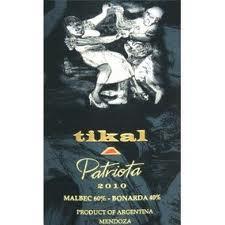
2010 Tikal Patriota, Mendoza, Argentina

01 Friday Mar 2013

Posted by musingsonthevine in Wines

≈ Leave a comment

I worry about the future of Malbec…

No, there is no great scourge awaiting this wonderful grape, prepared to wipe it from the earth, depriving all of us of its hearty pleasures. No, the threat is far more insidious… It is a threat that has hurt many grape varieties in the past, leaving their over cropped fruit hanging juicily on the vine, destined for that great vat of mass-produced jug wine… And what could this threat be?

I speak of, faddism… a fashion that is taken up with great enthusiasm for a brief period of time, a craze… Does the fate of Merlot and Pinot Noir jog your memory?

Malbec is perched on that slippery slope of becoming the next fad wine… or perhaps it is too late? Saving grace – while Argentina is hustling Malbec to market in every conceivable form, the French are doing what the French always do, shrug with a wily glint and walk away, letting you know that Malbec is their grape, originally, but not worth all the fuss. Bravo.

Actually, the Argentines are proceeding in a measured, if not somewhat zealous way, which bodes well. It may be that Malbec is just a little too edgy to actually become the next darling of the wine world. If Merlot and Pinot Noir have a certain smoothness and style that charms the palate, Malbec is the loud, boisterous college friend who is perpetually locked in frat party mode. Often full-bodied and unapologetic, Malbec is an in-your-face blast of black fruits and wild spices.

Another good sign… My Father-in Law eschews Malbec, despite my many attempts to convince him it is worthy of opening at table… Trend setter? No, but his taste in wine is classic and you can’t go wrong with the classics… He wears Brooks Brothers too… Need I say more?

But what about those youthful adventurers striving for the next great grape? Malbec isn’t sweet enough for their young palates… Have you noticed the sudden explosion of sweet reds on the market? Jellybean wines? Flip Flop wines? Yeah, Malbec is that scary guy in the leather jacket enjoying a few snake bites before a great game of darts… read “stay away…”

tikalpatriota

All of this makes me smile… Why? Because as long as Malbec stays just on the periphery of faddism, then wines like the 2010 Tikal Patriota are widely available at very reasonable prices. Tikal has a few different bottles of Malbec to choose from, but I think I like the Patriota the best. A blend of 60% Malbec and 40% Bonarda, the two grapes work together to create a pleasingly balanced wine with dark, inky fruit layered with exotic spices. I sipped it over two evenings and the wine held up impressively even without my usual Vineyard Fresh squirt in the bottle.

My tasting note:

Jammy nose with dark, blackberry and cedar hints. Full-bodied with moderate acidity and moderate tannin – good balance. Fruity with peppery, cherry and briarwood notes – mint and eucalyptus – youthful and vibrant. Moderate length with a smooth and layered finish – vanilla and allspice. Drinking well and should hold nicely for another 2 to 3 years.

At an average bottle price of $19.99 before the discount, this wine is a respectable value.

Cheers!

Newer posts →

Subscribe

  • Entries (RSS)
  • Comments (RSS)

Archives

  • June 2020
  • May 2020
  • April 2020
  • March 2020
  • February 2020
  • January 2020
  • December 2019
  • August 2019
  • February 2019
  • December 2018
  • November 2018
  • October 2018
  • September 2018
  • August 2018
  • July 2018
  • June 2018
  • May 2018
  • April 2018
  • March 2018
  • February 2018
  • January 2018
  • November 2017
  • August 2017
  • July 2017
  • June 2017
  • April 2017
  • March 2017
  • February 2017
  • January 2017
  • December 2015
  • October 2015
  • August 2015
  • July 2015
  • June 2015
  • December 2014
  • November 2014
  • August 2014
  • July 2014
  • June 2014
  • May 2014
  • April 2014
  • March 2014
  • February 2014
  • January 2014
  • December 2013
  • November 2013
  • October 2013
  • September 2013
  • August 2013
  • July 2013
  • June 2013
  • May 2013
  • April 2013
  • March 2013
  • February 2013
  • January 2013
  • December 2012
  • September 2012
  • August 2012
  • July 2012
  • June 2012
  • May 2012
  • April 2012
  • March 2012
  • February 2012
  • January 2012
  • December 2011
  • November 2011
  • October 2011

Categories

  • Cocktails
  • General
  • Restaurants
  • Spirits
  • Uncategorized
  • Wine Events
  • Wines

Meta

  • Create account
  • Log in

Blog at WordPress.com.

  • Subscribe Subscribed
    • blog.musingsonthevine.com
    • Join 36 other subscribers
    • Already have a WordPress.com account? Log in now.
    • blog.musingsonthevine.com
    • Subscribe Subscribed
    • Sign up
    • Log in
    • Report this content
    • View site in Reader
    • Manage subscriptions
    • Collapse this bar
 

Loading Comments...