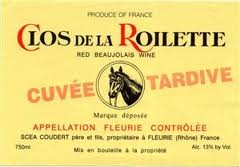
2010 Clos de la Roilette Cuvee Tardive, Fleurie

So, based on how much I enjoyed the 2009 non-cuvee bottling from Clos de la Roilette, I went back and actually bought some of the 2010 Cuvée Tardive. Wow, what a lovely wine and with quite a bit of aging potential to boot. The wine is definitely worth the $5.00 up-charge to $24.99 per bottle.

My tasting note:

Perfumed nose with floral, fresh cherry and mineral hints – Lovely. Medium-bodied with moderate acidity and firm, dry tannin – good balance. Tight with a dark fruit core – chewy with black cherry, tar and rose attar notes – dense. Long finish – closed with some spice on the aftertaste. Needs time, perhaps another 5 to 7 years before it even begins to open up.

Cheers!

March 2012 Wine Tasting Events

We are pleased to kick off our 2012 wine tasting season with two fun and exciting events in March…

March 17, 2012 – Wine & Chocolate @ 3:00pm

Cost: $50 per person

Location: Wrentham, Massachusetts

Adventurous chocoholics and lovers of fine wine are invited to join us as we experiment with various wine and chocolate pairings. At this event, we’ll examine different combinations of chocolate and wine to better understand how they can be paired for maximum enjoyment. We will taste a variety of milk and dark chocolate artisanal Candies, Chocolate-covered Strawberries, and Chocolate-Dipped Biscotti, and pair our delicacies with appropriate wines including Port, Sauternes, and Champagne. We’ll compare a wine in both its dry-fermented and dessert forms, and see how each pairs with chocolate. Join us for this indulgent experience, and learn how to match the flavors, sweetness, acidity, and texture of wines with chocolate.

And…

March 31, 2012 – Wine on a Budget @ 3:00pm

Cost: $50 per person

Location: Wrentham, Massachusetts

In the past I have conducted this tasting to focus on a specific region (say, Italy), but the time is ripe to look further afield of just one region and examine the flood of high-value wines available globally. I have long said that a person does not need to spend more that $10 to $15 dollars to find some pretty spectacular wine, and this event is going to prove it. At this event we will taste a number of wines from across the globe that represent good value ($10 – $15 range), some from lesser known regions and some from the usual suspects.

Contact: paul_malagrifa@musingsonthevine.com to reserve your seats today!


2009 Domaine de Fenouillet Ventoux

Domaine Fenouillet, a moderately-sized estate in the town of Beaume de Venise, France has a long-standing tradition of wine production. Patrick and Vincent Soard, the current stewards of the winery speak lovingly of their great grandfather Casimir and his pioneering work in the vineyard, work that apparently earned him a silver medal in 1902. His son Louis continued the tradition with award-winning Muscat de Beaume de Venise, of which a 1953 bottling maintains pride of place in the current cellar. Patrick’s and Vincent’s father Yvon maintained the tradition until falling ill in 1978 and becoming too sick to work in the winery. Fortunately Yvon taught his sons well and the quality of their wines is a testament to their love for the family tradition.

The estate produces a full range of wines including white AOC Vaucluse, white AOC Ventoux, rosé AOC Ventoux and red wines from AOC Beaume de Venise, AOC Ventoux and AOC Côtes du Rhône, in addition to fortified AOC Muscat de Beaume de Venise.

Interestingly, I could not find the 2009 Ventoux listed on their web site, but that doesn’t stop me from really enjoying the easy-drinking nature of the wine. Judging by the taste and the composition listed for their 2010 AOC Ventoux Cuvée Oversant, I’m guessing that the wine is largely Grenache (75%), with Syrah (20%) and Carignan (5%) to round out the party. At an average per bottle price of $10.99 the wine represents an excellent value and a perfect choice for an everyday drinking wine.

My tasting note:

Fresh, lively nose with cherry, dried herb and black pepper hints. Medium-bodied with moderate acidity and moderate, dry tannin – good balance. Black cherry, lilac and earthy tones on the palate. Quite quaffable. Moderate length with a smooth finish and cedar and spice on the aftertaste. Drinking well now and should hold for another 2 to 3 years in bottle. Great value!

Cheers!

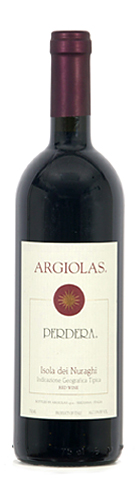
2009 Argiolas Perdera, Isola dei Nuraghi IGT

Sardinia, like Sicily is a spectacularly beautiful island off the coast of Italy with a long tradition of wine making. The various wine routes throughout the island lead to breathtaking landscapes where viticulture has been in existence since pre-Roman times, a tradition that began with the people of the nuraghi and continues today into the modern age. From the Romans to the late Sardinina-Piedmontese kingdom, through the Tuscan and Genovese fiefdoms, the Benedictine or Camaldolean monks and the Spaniards, each culture contributed to the wine making traditions in Sardinia.

Soil composition and climate play an important role in grape growing and wine production. With such a favorable combination of such elements, Sardinia is home to one of only four white DOCG wines: Vermentino di Gallura. Vermentino, with its delicate aromas of fruit and hint of almonds in the finish, is a wine to be enjoyed young. Vermentino di Gallura is typical of Sardinian wines – beauty, delicacy with exotic character and seductive flavors.

This piece is not about Vermentino, but instead I am writing about a stunning little red wine made by the Argiolas family. The winery was founded in 1937, and consists of approximately 575 acres in the breathtaking land just north of the town of Cagliari in southern Sardinia. The winery produces 2.3 million bottles annually across eleven different wines. The Perdera is a blend of 90% Monica, 5% Carignano and 5% Bovale Sardo grown in the eponymously named vineyard. The Perdera vineyard is 74 acres of primarily clay and limestone, situated at an elevation of 650 feet above sea level. The average age of the vines is 32 years with a fairly stingy yield of 3.2 tons/acre. The wine is fermented in stainless steel tanks and then aged for about six months in French oak casks, which gives the wine a smooth, silky finish. The intense ruby color is a hallmark of the Monica grape, a Spanish transplant that oddly is no longer found in Spain. While not a candidate for long aging, the Monica grape produces fresh, lively wines with exotic spiciness that are eminently quaffable. At an average per bottle price of $11.99, the Perdera makes for an ideal daily-drinker!

My tasting note:

Earthy, barnyard nose with fresh cherry, floral and allspice hints. Medium-to-full-bodied with firm acidity and dry tannins – good balance. Dark fruit core with tarry, plumy notes. Moderate length with a spicy, dried fruit aftertaste with hints of cedar and vanilla. Drinking well now and should hold for another 3 to 5 years in bottle. Great value!

Cheers!

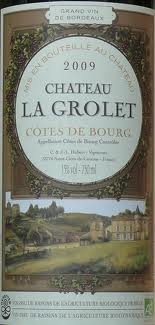
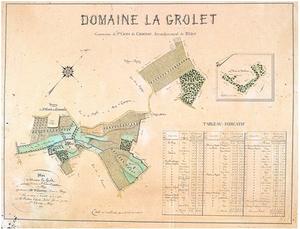
2009 Château la Grolet, Côtes de Bourg

Catherine and Jean-Luc Hubert are the owners of a number of properties in Bordeaux, one of which is Château la Grolet, a fully-biodynamic winery that strives to achieve purity and complexity in its wines without compromising the surrounding environment. The vineyard is composed of 38 hectares (92 acres) of primarily clay-laden soil in the Côtes de Bourg. Varietal composition consists of 65% Merlot, 30% Cabernet Sauvignon and 5% Malbec, which contributes to the wine’s somewhat tannic character.

At an average per bottle price of $14.99 the wine represents a very good value in a superb vintage for Bordeaux.

My tasting note:

Earthy nose with mineral, menthol and black cherry hints. Medium-bodied with moderate acidity and firm, dry tannin – good balance. Black cherry palate with dark chocolate, anise and stewed black currant notes. Moderate length with a tight, compact finish and a hint of cedar and spice on the aftertaste. Needs a bit of time, perhaps another 2 to 3 years will improve the wine. Good value.

Cheers!

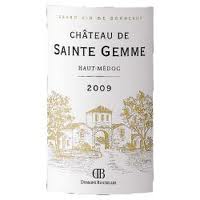
2009 Château de Sainte Gemme Haut-Médoc

With all the hype surrounding the 2009 vintage in Bordeaux I have taken to looking for smaller, less expensive properties. Thus far the strategy has paid off, producing a spate of low-to-mid-priced wines that have the unmistakable flavor profile of classic Bordeaux from a great vintage.

The Sainte Gemme is a blend of 50% Cabernet Sauvignon and 50% Merlot coming from vines that are on average 20 years old. The vineyard is approximately 10 hectares (24.3 acres) and is on soil composed of a mix of gravel, clay and limestone, which likely accounts for the minerality on the nose. The estate is what I would call mid-sized, producing approximately 80,000 bottles per year.

At an average per bottle price of $19.99 the wine represents a very good value in a superb vintage for Bordeaux.

My tasting note:

Minerally nose with menthol, eucalyptus and black cherry hints. Medium-to-full-bodied with moderate acidity and firm, dry tannin – good balance. Dark fruit core with gamey, dried cocoa notes – herbaceous. Moderate length with a classic Bordeaux finish. Drinking well and should improve for another 3 to 5 years.

Cheers!

2009 Domaine la Berangeraie Cuvée Maurin Cahors

With the current focus on Argentine Malbec, I feel genuinely bad for the wines of Cahors, the region in southwestern France that Malbec calls home. Cahors is a full-bodied red wine made from grapes grown in or around the town of Cahors in France. The region was granted AOC status in 1971. As I mentioned previously, the principal grape variety used in Cahors wines is Malbec, which must make up a minimum of 70% of the wine, and which is known locally as Côt, Côt Noir or Auxerrois. It can be supplemented by up to 30% Merlot and Tannat. Because of the high percentage of Malbec in the wine, Cahors wines can be rather tannic when young, and benefit from long aging. Approximately 4,200 hectares (10,000 acres) are under vine in Cahors. Officially, the Cahors AOC may only be used for red wines. There is a small amount of white and rosé wine produced in the region, and it is sold under the designation Vin de Pays du Lot, not Cahors.

Winemaking in Cahors goes back to the time of the Romans, with evidence of grape cultivation extending back as far as 50 B.C. Wine production has been continuous since then, which underscores the importance of the region in France. During the Middle Ages, the wine of Cahors was called “the black wine of Lot” (named for the river that flows throught the region) and it was a wine of significant importance in France. It was on the wedding tables at the marriage of Eleanor of Aquitaine with Henry II of England. Pope John XXII, born at Cahors, made it his table and sacramental wine. Francis I of France appreciated it to the point of delegating to the Cahorsin vintners the task of creating the vineyard of Fontainebleau. The Russian Emperor Peter I of Russia drank Cahors and the Russian Orthodox Church adopted it as its sacramental wine. Since the wine’s introduction to the court of England, Cahors wine even became a formidable competitor to Bordeaux wine. The Bordelais vintners attempted to prevent the sale of Cahors wine before All Saints Day to stop its production, but Louis XVI resolved the conflict by providing mediation between the “warring” vintners.

Like many other winemaking regions in France, Cahors was devastated by the Great French Wine Blight in the late 19th century, when grape vines across France were attacked by the phylloxera root-louse epidemic. Cahors fell victim to the disease between 1883-1885 and it was at this point the vine found its way to South America. Cahors had another brush with disaster In February of 1956, when frosts wiped out nearly all the vineyards in the region. A massive replanting effort was undertaken and as a result, the composition of grape varieties changed substantially, giving Malbec its dominant status.
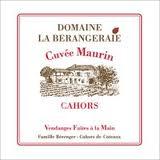
The Cuvée Maurin is classic Cahors – full throttle, with massive quantities of firm, dry tannin and a dense, dark core of fruit – spectacular with prodigious aging potential. Knowing the above history, the wine “feels Medieval” and seems like it would be quite at home on the tables of Popes and Kings alike. The best part – at an average per bottle price of $17.99, this wine is a tremendous value.

My tasting note:

Powerful nose – dense and earthy with dried herb, currant and anise hints. Full-bodied with moderate acidity and firm, dry tannin – good balance. Massive – tight with plumy fruit and cedar, tar and rosemary notes. Wow! Long finish with a jam-packed aftertaste – very  tight – needs time, perhaps 10 to 15 years before the wine will really shine. Outstanding!

Cheers!

2009 Clos de la Roilette Fleurie

I was visiting my chums at the Wine & Cheese Cask in Somerville, MA last week to pick up a number of wines from their most recent newsletter. One of the wines, the 2010 Clos de la Roilette Cuvée Tardive piqued my interest, largely because in the brief description, reference was made to the “2009 regular bottling” being both outstanding and, more importantly – still available. Sure, enough the 2009 regular bottling was in the store, so I picked some up to try. Needless to say, the wine is fantastic and at $19.99 per bottle, a respectable value. Yet another 2009 Beaujolais that is just stunning.

I enjoyed the wine so much, I will likely go back to give the 2010 bottle a try…

My tasting note:

Ripe nose with fresh cherry, lilac and wildflower hints. Medium-bodied with moderate acidity and smooth, supple tannin – good balance. Fruity palate with black cherry, plum and tar notes – lush. Moderate length – quaffable. Drinking well now and should hold for another 2 to 3 years in bottle.

Cheers!

2009 Domaine Sainte-Eugénie Corbières

Corbières is a French wine region located below the southern Rhone valley in an area called Languedoc Roussillon. The sun-splashed vineyards produce ripe grapes that create wines that are lush and quaffable, which in really good vintages have structure and balance to rival their cousins in the Rhone. Domaine Sainte-Eugénie is located in the heart of the region in an area called Fontfroide and has a wine making tradition going back over 800 years. The soils in the vineyards are primarily clay and chalk, largely due to their proximity to the Pyrénées Mountains. The dry, sunny and warm Mediterranean climate provides near-perfect growing conditions for the blend of Carignan (50%), Grenache (25%) and Syrah (25%) that make up this wine. I only just started following this producer in 2005, but the two successive vintages I have tasted, 2007 and 2009 have been tremendous. At an average price of $9.99 per bottle, clearly this is another southern French producer I will be adding to my list.

My tasting note:

Spicy, earthy nose with fresh herb, black cherry and violet hints. Medium-to-full-bodied with moderate acidity and supple, well-integrated tannin – good balance. Dark cherry palate with cocoa, rosemary and tarry notes. Moderate length, smooth and seductive with echoing spice and violets off the nose. Drinking well now and should hold for another 2 to 3 years in bottle. Great Value!

Cheers!

The French 75

I love a good story, even better when the story is told about a fantastic cocktail!

The French 75 is a classic, pre-prohibition cocktail first created at the New York bar in Paris, France in 1915. The cocktail derives its name from one of the world’s most formidable field guns at the time, the French 75mm Howitzer. It was said by imbibers at the time that the cocktail possessed the kick of a French 75. Harry Craddock, who first recorded the recipe in The Savoy Cocktail book in 1930, remarked that the drink “hits with remarkable precision!”

The French 75 is also a cocktail not without some controversy. The recipe in Craddock’s book records gin as the cocktail’s base spirit, to which one adds lemon juice, sugar and then Champagne to finish up. In David Embury’s The Fine Art of Mixing Drinks (1948), one of my favorite cocktail guides, the base spirit is listed as Cognac. Much more French, I’d say, but with a decidedly heavier presence.

I’ve tried both versions and think they are just wonderful in their own way. The gin-based version has a lively palate that is refreshing and tart with a complex nose from the botanicals of the gin (I chose Tanqueray 10 as the base). The Cognac-based version has more depth and body with pleasing hints of vanilla and caramel – almost like a Sidecar with bubbles… In any event, the cocktail is visually striking and a fine way to awaken one’s spirit after a long day in the trenches!

The French 75 (Classic)

2 oz. London Dry Gin

2 tsp of super fine sugar

½ oz. lemon juice

5 oz. Brut Champagne (approximate)

Vigorously shake the gin, sugar and lemon juice with crushed ice. Strain into a Champagne flute and top off with Brut Champagne. Garnish with a twist is optional.

Cheers!