2010 Elk Cove Vineyards Pinot Gris, Willamette Valley

As far as grapes go, Pinot Gris has a pretty tough life… As Pinot Grigio, this grape has contributed to millions of gallons of insipid and watery Italian white wine that frankly has less character than the Aqua Minerale perched next to your order of Bruschetta. Thankfully this is changing and producers like Alois Lageder are proving that Pinto Grigio can make respectable wine. Across the Alps into France the grape fairs better, but is often beaten out by the competition – Pinot Blanc, Riesling and the ever exotic Gewurztraminer. The racy acidity that is often a hallmark of well-made Pinot Gris is underappreciated when put beside the alluring characters of its brethren. Domestically, Pinot Gris is often lost in a sea of buttery Chardonnay, competing like a plain-Jane wall flower at the High School prom against the likes of Pamela Anderson during her best Bay Watch years.
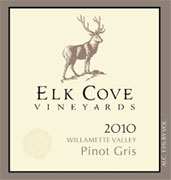
Thankfully, winemakers in the Pacific Northwest have found that the growing conditions are a perfect match for producing wonderful Pinot Gris and the folks at Elk Cove Vineyards are masters with the grape. Expressive, beautiful with a pleasingly crisp palate – what more could one ask for in a wine? At an average retail price of $19.99 per bottle it may not be the cheapest wine on the shelf, but it sings “value wine.”

My tasting note:

Bright, lively nose with citrus, floral and mineral hints – lovely and seductive. Medium-bodied with racy acidity – crisp and clean – very well-balanced. Tart, mouthwatering with good mid-palate fruit – lemony with subtle pear and green apple notes. Moderate length with a pleasant, lingering finish. Drinking well now – not for aging, but the screw cap closure will ensure some longevity.

Cheers!

2009 Château Veyrin, Listrac-Médoc

At the Smart Wine Shopping event at Martignetti’s we tasted through a number of really nice wines, all positioned as high-value – meaning not necessarily cheap, but certainly worthy of spending your hard-earned wine dollars to acquire… One wine of note is a tasty little gem from Bordeaux, produced in the modest commune of Listrac-Médoc. Not as famous as some of the other communes along the left bank, Listrac-Médoc can produce, in great vintages, wines that deserve attention. The other nice aspect of Listrac-Médoc is that its modest stature means modest prices, usually.

The 2009 Château Veyrin is virtually unknown, at least to me anyway, but I’m less about notoriety and more about what’s in the bottle. And there is quite a bit in this bottle. Plumy, chewy with nice structure make this wine a real winner, especially at an average retail of $17.99, pre-discount.

My tasting note:

Fresh cherry fruit nose with characteristic mineral, tobacco leaf and mint hints. Medium-to-full-bodied with moderate acidity and moderate tannin – good balance. Black currant palate with menthol and plum notes. Moderate length with a tight finish. Drinking well and should improve with another 3 to 5 years in the bottle. Super value in a stellar vintage.

Cheers!

2009 Cypress Cuvée (Blended by Kermit Lynch), Côtes du Rhône

I told you so… 2009 is stacking up to be one of those vintages where everything I put in my mouth is just sensational. In 2000, when the 1998 Southern Rhone wines came to market, we bought over 65 cases of Chateauneuf du Pape alone. We can’t do that again without buying another house to store all the wine in… We can’t do that again… Hmmm…

Kermit Lynch is known by many to be one the ground-breaking negociant/importers that specializes in small, out of the way producers that make terrific wines. That was many decades ago and now his fame lends itself to “private” label wines of his own creation. With the 2009 Cypress Cuvée, Mr. Lynch did alright… especially at an average retail cost of $15.99…

My tasting note:

Youthful, earthy nose with fresh cherry, strawberry and truffle hints. Medium-to-full-bodied with moderate acidity and firm, dry tannin. Good balance. Lush palate with blackberry, cacao and gamey notes – classic CDR. Long finish with spice and dried fruit notes – like a Vino Ripasso! Drinking well and should easily improve for another 5 to 7 years in the bottle. Great value!

The Kermit Lynch web site states the 2009 vintage is 80% Syrah and 20% Grenache, clearly verified by the structure and spicy notes. I don’t have production numbers, but I would not dawdle – wine this good will not last long!

Cheers!

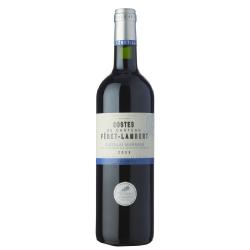
2009 Costes du Château Féret-Lambert, Bordeaux Supérieur

I have always told my classes that in highly-touted Bordeaux vintages, such as 2000, 2005 and now 2009, often times the best place to look for top quality wines at modest prices is in the lesser properties, or second labels of classified wines. Bordeaux has become such an expensive commodity that finding affordable, classified wines is no longer an option for most buyers. This is especially true in recent vintages. So, when a wine like the Costes du Château Féret-Lambert shows up, I take notice.

I tasted this wine as a part of the selection process for redeveloping the Harvard Faculty Club wine list and the wine is, in a word: stupendous. At an average retail somewhere around $15.00, this wine is off the charts. Primarily Merlot (90%), as you would expect from the AOC, the property states soil types of clay, limestone and fossilized coral, which certainly comes through on the palate. Moderate oak aging and progressive wine making techniques have combined to produce a real star.

My tasting note:

Lush, black currant nose with jammy, mineral and cedar hints. Medium-to-full-bodied with moderate acidity and firm, structured tannin – great balance. Dark fruit core with black cherry, bittersweet chocolate and tar notes. Wow! Moderate length with a super smooth finish. Drinking well now and should continue to improve in bottle for another 5 to 7 years, perhaps more. Simply a superb value.

So my advice – although 40,000 cases were made, I would run to my local purveyor and take home at least a case. Cheers!


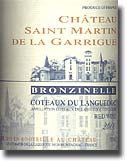
2009 Chateau Saint Martin de la Garrigue – Bronzinelle

I have a feeling that I am going to be posting a lot about European wines from the 2009 vintage… So far, 2009 is reminiscent of other vintages like 1997, 1998, 2000, 2005 and 2007…

I picked up several wines the other day and gave one a try – Chateau Saint Martin de la Garrigue Bronzinelle, from Coteaux de Languedoc. What a gem! The wine is structured and delicious – my note follows:

Lively nose with black raspberry, fresh cherry and dried herb hints. Full-bodied with moderate acidity and firm, chewy tannin – great balance. Dark fruit core with spice, cedar and cacao notes. Moderate length with a tight, layered finish. Drinking well and should continue to  evolve and improve for another 5 to 7 years in bottle. Great value.

At $15.99 (average retail, pre-discount) per bottle, this is a  real charmer – true, past vintages of this wine were closer to $10.00, but at the current price, the wine still represents a magnificent value. The wine should have wide availability.


Every so often one gets by…

I’ve been enjoying the 2009 wines from Europe, mostly France and loving the richness and depth of flavors. Some 2010 wines have tickled my fancy, but there are many more of those arriving over the next year, or so… And then, sometimes an “older” vintage shows up and, wham! You remember how great certain past vintages are. Take 2007 – a stellar vintage in Europe, especially in France and Italy… I was tasting some wines for possible addition to Harvard Faculty Club’s wine list and came across this gem:

2007 Chateau de Lascaux Coteaux de Languedoc ($14.99 approximate retail)

Dense, earthy nose with black cherry, cocoa and dried herb hints. Full-bodied with moderate acidity and supple tannin – good balance. Cherry, blackberry jam and black currant palate – youthful with mint and licorice notes. Long finish – smooth – tight, showing a nice layered complexity. Drinking well now – should continue to hold for the next 3 to 5 years. Good value.

(I picked up a case at Martignetti’s in Brighton – the current vintage at most shops is 2008)


A few new Rhones…

If France is my favorite wine producing country (and this is tough given my penchant for Italian and Spanish wines…), then the Rhone is probably my favorite region within France. The originator of the wine that smacked me square in the forehead and started me on my wine journey 28 years ago, the Rhone is a region steeped in history and amazing wine. This has certainly been true over the last decade, as the Rhone has had a string of near perfect vintages stretching back to 1994, save one – 2002. The one downside to all these great vintages is that the Rhone is no longer a region of consistent value. Prices have escalated and what used to be a fine $9 – $10 Cotes du Rhone is now $15 – $20. The wine is still great, the prices not so much… I have posted the occasional find in two recent vintages 2007 and 2009, both regarded as exceptional vintages on a par with the near perfect 1998 vintage and now 2010 wines are making their way to market. Regarded as a very good vintage, 2010 is quietly being referred to by some critics as a “shadow vintage,” meaning that it is following in the shadow of a truly memorable and massively-hyped vintage: 2009. The benefits to a shadow vintage are that the quality is usually very good with somewhat moderate prices and great availability.

Two recent finds are:

2010 Saint Cosme Côtes du Rhone $14.99 (approximate retail)

Earthy nose with dense tarry fruit hints and anise and dried mint leaves. Full-bodied with firm acidity and moderate tannin – good balance. Fruit forward palate with dark berry notes – herbaceous – youthful. Moderate length with a smooth, layered finish. Drinking well – should hold for 3 to 5 years.

2010 Domaine la Garrigue Cuvée Romaine $14.99 (approximate retail)

Fresh, fruity nose with dried herbs and floral hints. Full-bodied with moderate acidity and supple tannin – good balance. Youthful, fresh cherry palate with tar, rose attar and allspice notes – exotic. Moderate length with a persistently herbaceous finish. Smooth. Drinking well now – should hold for 2 to 3 years.

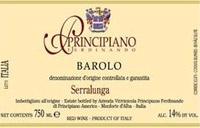
2006 Principiano Serralunga Barolo

I generally have a set of “go-to” wine stores in the area, ones that I have been frequenting for over 25 years. The lengthy history is due to the fact that either the people, the wines, or both have developed a track record of satisfying. These are my preparatory remarks to a cautionary tale – one that I know too well (admitted somewhat sheepishly)…

I receive a number of mailings (electronic and paper) from lots of wine outlets, including many on my “frequented” list. One in particular is a real favorite – The Wine & Cheese Cask in Somerville, MA. The Wine Cask is a place of permanence… The small, cramped store has not changed one iota since I first stepped through the door back in 1985 – 26 years and the floor-to-ceiling, rustically-appealing wine racks are still the same dusty dark brown. To boot, the Wine Cask still faithfully mails out a paper monthly newsletter, filled with lots of fun and exciting wine. Mails… as in USPS… who does that anymore? But you know what? I eagerly anticipate each issue… more so than any other newsletter.

With over 25 years of reading and buying from the Wine Cask I’ve learned that sometimes the descriptions of the featured newsletter wines are a wee bit enthusiastic, with language that is equivalent to air-brushed celebrity photography… Not really misrepresentation or false advertising, just one person’s interpretation… I’ve learned this the hard way… need I say more?

Anyway, what does all this have to do with the 2006 Principiano Serralunga Barolo? Well, the wine was in the September-October Wine Cask newsletter, and I quote:

Is it possible to have too many good vintages? Some Piemontese producers must be wondering this as their cellars are full of Barolo and prices appear to be dropping. We are certainly glad to take some stock off their hands. This is the second vintage in a row that we are able to sell for $29.99 from Principiano. The 2006 is a ripe, full bodied Barolo with deep yet delicate fruit and impressive yet flexible tannins. Decant this or let it breathe for a few hours to allow the flavors to knit together. Or age this impressive red for another five years. A great wine for a roast leg of lamb.

Who wouldn’t race to the Wine Cask to buy a case? Barolo with this kind of description at $29.99 – are you kidding me? So off I went to liberate a case for our pleasure… Popped one open last night and found myself re-reading the above description, over and over again… after each sip as a matter of fact… Must have given me the wrong wine, I thought, because all I tasted was TANNIN. And I don’t mean nicely structured, firm tannin that is balanced harmoniously by ripe fruit. No, I mean rip the skin off the inside of your mouth and leave you puckering like a dying camel after crossing the Sahara tannin. Ripe fruit? I’ve been tasting wine for ne’er 30 years and I think I know ripe fruit when I taste it and this ain’t it… My notes went like this:

Tight nose with hints of dried cherry, saddle leather and violets – pretty, though restrained. Full-to-medium bodied with punishing tannin and firm acidity – poor balance. Closed palate with any fruit flavors driven into obscurity by the overabundant tannins. Harsh. Long finish, although not particularly pleasant – this wine needs time. If the fruit is hidden beneath this veil of tannin, then there may be hope with some time. Otherwise this wine was a dud…

Am I angry? No. Given my relationship with the Wine Cask, if I complained I am sure they would happily refund my money. Besides, I didn’t follow my own rules of engagement: buy a few test bottles before committing to a full case – My bad, in other words. Why not return the wine anyway? Despite what many people say about me, I’m an optimist when it comes to wine. I’ll hope that sometime over the next 20 years, this wine will blossom. I’ve been witness to this kind of transformation before, so it is not impossible. Bottle variation is a specter as well, although what I tasted does not suggest issues with bottle variation.

So – the take aways:

  • I will still continue to eagerly await the arrival of the Wine Cask’s monthly newsletter…
  • I will still rush into the Wine Cask and buy those newsletter wines that tickle my fancy…
  • I will repeat the words “only buy a few bottles to try” as I cross the Wine Cask threshold…
  • I will wait patiently for the 2006 Principiano Serralunga Barolo to shed its cocoon of harsh, mouth-punishing tannins to become the lovely, enticing bottle of Barolo that I crave… and I’ll be telling stories of how I paid less than $30 per bottle at a time when classic Barolo was selling for three times as much…


2006 Castello Banfi Brunello di Montalcino

The wines of Italy used to be wines of tremendous value, not always the finest or most ageworthy, but just good, solid values. Then something changed… a string of successive vintages where the flagship wines of Barolo, Barbaresco, Brunello di Montalcino and those pesky “Super Tuscans” were all absolute gems! Say goodbye to value and hello to the inevitable price creep.

All that aside, sometimes it just doesn’t matter… Last night we enjoyed a fabulous bottle of Brunello from a long-favorite producer: Castello Banfi. We have been enjoying these wines since the mid-90’s and have had the fortune of collecting a nice little vertical.. Well the 2006 needs to find a way into our cellar – magnificent, majestic with refined, yet potent tannin. Deep, dark fruit core with a wonderful melange of flavors: anise, cherry, cocoa dust, saddle leather and violets delight the palate. Long on the finish, smooth, suggesting many years of aging potential, perhaps 15+ years.

The wine went perfectly with our food: a perfectly trimmed filet and a gigantic stuffed veal chop – Heaven!

Italian Bitters


I’m reading Boozehound: On the Trail of the Rare, the Obscure, and the Overrated in Spirits by Jason Wilson. It started slow, but has picked up steam. Quite a few interesting cocktail recipes and entire chapters devoted to arcane spirits that until now I merely gazed at and wondered… “did the world really need an artichoke-based digestif?”


So I ventured forth in search of a class of spirit termed the Italian Bitter, or Amaro. When one goes in search of Amaro, it turns out you end up having to try a bunch of related goodies that are not quite Amaro, but are “part of the experience.” The things I do in the name of learning…


First up is the classic Averna, an Amaro Siciliano that was actually quite nice. Sweet with a Mocha-Coffee flavor that was smooth and balanced. I could see sipping this and relaxing after a nice bowl of Tripe, or Gnocchi Bolognese. And there are a pair of really nice cocktails that use Averna:


Black Manhattan


2 oz. Rye


3/4 oz. Averna


1 d Angostura Bitters


1 d Orange Bitters


Intercontinental


1-1/2 oz. Cognac


1 oz. Averna


1/2 oz. Maraschino Liqueur


Both recipes involve shaking the ingredients with crushed ice and straining into a cocktail glass.


Next up is something a little more unusual – Santa Maria Al Monte Amaro… In Sushi restaurants sea urchin is considered “challenging.” Well, this amaro is the sea urchin equivalent of the spirit world – Elements of pine sap with an extremely bitter finish – eye-opening is a good description. I could not find any cocktail recipes that would use this spirit and sipping as a digestif would be an acquired taste for sure…


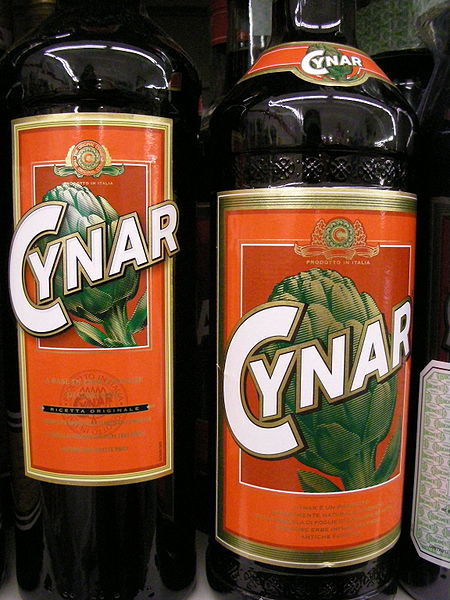
Next we tasted Cynar – an artichoke-based (Cynara Scolymus) liqueur that was quite interesting. Sweet with herbaceous bitterness, almost like a richer version of Campari. I found a cocktail that is quite refreshing, ala Satan’s Whiskers…


Cyn-Cin


1 oz. London Dry Gin


1 oz. Sweet Vermouth


1 oz. Cynar


1 d Orange Bitters


2 Orange Wedges


Shake the spirits and the juice of one orange wedge with crushed ice. Strain into a cocktail glass and toss in the remaining orange wedge.


Next up, Fernet-Branca a bitter spirit made with neutral grape spirit as the base. Whoa is the only word I can use to describe the experience… Menthol, mint and extremely bitter – takes some getting used to…


Last up – Punt e Mes Vermouth – Punt e Mes literally means “point and a half” in Piedmontese. It has been said that it owes its name to a sudden raise of the stock market (naturally, of a point and a half) which greatly benefitted the Carpano distilleries, which then created the vermouth brand to commemorate the occasion. Alternatively it may refer to the flavor being characterised as one ”point” of sweetness and half a point of bitterness. Punt e Mes can be used interchangeably with any other Rosso Vermouth, or in a cocktail of its own design.


Red Hook


2 oz. Rye


1/2 oz. Punt e Mes


1/4 oz. Maraschino Liqueur


Shake with crushed ice and strain into a cocktail glass.


So ends the journey for now… The moral of the story is to always keep an open mind and expect the unexpected.

(Originally posted on Facebook: June 25, 2011)