2009 Sean Minor Red Wine, Napa Valley, California

I think I have earned a bad rap… My students and event attendees will tell you that I am highly-critical of California wine. I liken my relationship to California wine to the relationship I have with my son, described by a single phrase: high expectations… Call it tough love, but I think that producers in California can do more to produce wines with character at far-more reasonable prices than their European counterparts, but often our domestic winemakers fall short of the mark. There are exceptions – Steven Rogstad at Cuvaison for one – a European-trained winemaker of tremendous talent that produces some really tasty wine. Michael Pozzan – with roots stretching back to Italy’s Piedmont region is another talented winemaker. And we have Sean Minor. According to their website, Minor Family wines are about producing better quality wines that won’t break the bank. After having tasted all of the wines produced by the team, I have to say that they have accomplished their mission. In October of last year, I tasted the Chardonnay and Pinot Noir offerings – quite classy renditions that had many distinguishing characteristics and, like the web site promised – didn’t break the bank. Recently I enjoyed their Napa Valley offering that I would call a Meritage, except Sean Minor is not a member of the Meritage Club, nor is the wine really composed of the correct varietals. The composition of the wine is 30% Merlot, 23% Petit Verdot, 17% Zinfandel, 16% Petite Sirah, 10% Syrah,and  4% Malbec, which combine to produce a quaffable, yet structured blend – I think the word I used was “yummy!” At $19.99 average retail, the wine is an pretty good value…

My tasting note:

Ripe, fruity nose with cherry, blackberry and violet hints. Full-bodied with moderate acidity and firm, dry tannin – good balance. Structured with a dark fruit core and tar, tobacco and jammy notes. Smooth. Moderate length with a layered, evolving finish. Drinking well now and should hold for another 3 – 5 years in bottle. A pleasant value…

Cheers!
Another few minutes of fame…

Well, a few weeks ago I was interviewed for a piece on Bloomberg.com about the “Real Cost of Being and Oenophile.”

Many of the tools that the researcher used were from my Musings web site and we spent some nice time discussing this little obsession of mine…

The piece can be found at: http://www.bloomberg.com/money-gallery/2011-12-08/the-real-cost-of-becoming-an-oenophile.html#slide2

Enjoy!

Napa versus Bordeaux – Where do we stand?

In 2004 I decided to try an experiment… While I could not duplicate the exact wines from the now famous Judgment in Paris tasting of 1976, I thought matching up some of the best Cabernet Sauvignon-based wines from Napa Valley and those of Bordeaux would be a fun, competitive way to spend an afternoon. Seven years and four tastings later, I have a veritable wine-bath on my hands. I thought it would be fun to look over the four tastings and see how things are fairing.

The first installment took place on October 16, 2004. I was looking to taste a set of six wines that were at equivalent quality levels with the same degree of maturity and drinkability. The results were as follows:

By Wine

Wine

1st

2nd

3rd

Total

(3 pts)

(2 pts)

(1 pt)

1991 Heitz Trailside Vineyard

0

1

1

3 pts

1987 Spottswoode

0

0

2

2 pts

1987 Forman

0

2

1

5 pts

1990 Leoville-Barton

1

1

0

5 pts

1990 Pichon-Baron

3

0

0

9 pts

1990 Haut-Brion

2

2

1

11 pts

By Region

Napa Valley

10 pts

Bordeaux

25 pts

The next installment took place on April 21, 2007. California was looking for payback, but we were committed to keeping an even playing field. Once again I tried to match wines of equal breeding that were showing well. The results were as follows:

By Wine

Wine

1st

2nd

3rd

Total

(3 pts)

(2 pts)

(1 pt)

1994 Forman

0

1

4

6 pts

1996 Dunn

6

2

1

23 pts

1994 Joseph Phelps Insignia

4

2

3

19 pts

1995 Fieuzal

1

4

1

12 pts

1990 Lynch-Bages

1

2

3

10 pts

1990 Haut-Brion

4

2

1

17 pts

By Region

Napa Valley

48 pts

Bordeaux

39 pts

So with the score tied 1 to 1, a rematch was called for and on October 10, 2009 Napa squared off against Bordeaux for the third time. In this installment I dug deep to find some really special bottles, wines that at the time of their release were considered spectacular. The results were as follows:

By Wine

Wine

1st

2nd

3rd

Total

(3 pts)

(2 pts)

(1 pt)

1987 Dunn

0

1

0

2 pts

1987 Opus One

0

0

0

0 pts

1987 Caymus Special Select

4

2

0

16 pts

1983 Kirwan

1

2

1

8 pts

1988 Cheval Blanc

4

1

0

14 pts

1986 Margaux

0

2

0

4 pts

By Region

Napa Valley

18 pts

Bordeaux

22 pts

France barely pulled out a victory, so it was inevitable that a fourth match-up would need to take place. On October 22, 2011 the mighty regions squared off again this time with wines from one of the best vintages of the last century. The results were as follows:

By Wine

Wine

1st

2nd

3rd

Total

(3 pts)

(2 pts)

(1 pt)

1987 Silver Oak

1

0

1

4 pts

1985 Dunn Howell Mountain

2

1

1

9 pts

1985 Heitz Martha’s Vineyard

0

0

1

1 pts

1985 Clerc Milon

0

1

1

3 pts

1985 Pavie

5

1

1

18 pts

1985 Lynch-Bages

4

4

0

20 pts

By Region

Napa Valley

14 pts

Bordeaux

41 pts

So after four installments, France has a commanding lead with 3 check marks in the win column. Point-wise the French have 127 points to Napa’s 90 points, a fairly sizable margin. Where does it go from here? Well if history repeats itself, I imagine a fifth match-up in 2013, either in April, or October…

Should be fun, as usual!

BonCaldo Restaurant – Norwood, MA

I have, on occasion reviewed restaurants for my readers, believing that folks who enjoy fine wine also enjoy fine food and not just in their own kitchens…

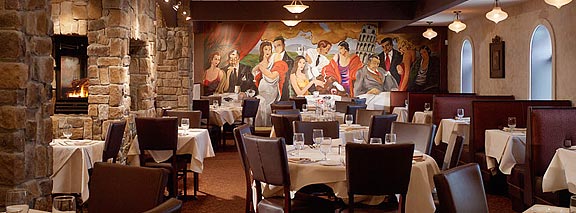
We found ourselves at BonCaldo, our first visit, celebrating joint birthdays. As far as ambiance goes, BonCaldo was fairly standard – well lit, a little cramp and playing piped-in music that was a little too loud. Wait staff was reasonably attentive, although a dirty appetizer plate was never replaced, despite being requested, and it took several requests to replenish the bread basket. I noted too that the server, who was not the same person as our actual waiter was quite a surly individual, who was not particularly accurate when delivering our main courses…

As far as food goes, the quality was quite high, very good in fact, despite portions being on the small side. We started by sharing a few appetizers: Melanzana alla Parmigiana [SICILIA] eggplant – Calabro ricotta – mozzarella – San Marzano tomato sauce $7.95 and Calamari Fritti [LIGURIA] fried tubes & tentacles – hot cherry peppers – garlic & lemon aioli drizzle $9.95. The Melanzana was a rich, hearty treat. The Calamari was a bit disappointing – somewhat oily, devoid of hot cherry peppers with a weakly-flavored aioli…

On to the main courses: Gnocchi di Ricotta [TOSCANA] hand crafted “pillows” of ricotta cheese – tomato sauce – pecorino $9.95 / $14.95, Vitello alla Saltimbocca [LAZIO] veal cutlet – Prosciutto di Parma – sage – white wine – polenta – spinach $20.95 and Vitello alla Marsala [SICILIA] veal cutlet – prosciutto – mushrooms – Marsala wine – buttered linguine $20.95. The Gnocchi was heavenly – truly “pillows” of ricotta that melted in your mouth. The saltimbocca was great with a pleasantly biting sauce – the polenta was perfect, having a creamy richness and buttery, nutty flavor. One diner suggested taking a gallon or two home for later enjoyment… The Marsala was good, although I prefer mine a trifle creamier and served traditionally with the pasta on the side, as opposed to mixed together ala ragout. Overall, the food was excellent, albeit as noted, the portions were on the smaller side.

We had two wines with dinner: 2009 Planeta, Cerasuolo di Vittoria DOCG $45 (60% Nero d’Avola, 40% Frappato) and the 2009 Tomaresca Neprica, Puglia $32 (40% Negroamaro, 30% Primitivo, 30% Cabernet Sauvignon) – both wines were very nice, the Planeta was the splashier, fruitier of the two, with the Tomaresca having more structure and dark fruit overtones. Prices were fair, hovering between 2-1/2 to 3 times retail.

Dessert brought a trio of sweet treats: Cannoli, Tiramisú and Budino. The cannoli was freshly-filled with a crisp shell, but the filling was lack-luster and tasted more like whipped cream than creamy ricotta. The tiramisú was good, although a bit sweet and lacking the strong espresso bite that we prefer. The budino, or traditional Italian bread pudding, was the best of the trio, showing sumptuous, creamy layers that melted in your mouth.

Dessert was enjoined by something rarely found, a flight of three Italian Amari, or bitter digestifs. The overall after-dinner drink list was appreciably dizzying – much welcomed as this aspect of restaurant wine lists is often lacking in depth… Commendable and delicious! We had the Nonino, the Lucano and the Ramazzotti, none of which I had tried previously and all of which sang the praises of Amari.

Would we return to BonCaldo? Definitely YES! The few noted shortcomings were not enough to offset the overall quality of the food – the Wine Spectator Award-Winning wine list was fairly priced and as previously mentioned the digestifs were simply amazing.

http://www.boncaldo.com/

The Boulevardier

According to Ted Haigh in Vintage Spirits and Forgotten Cocktails, the Boulevardier was a Prohibition-era cocktail invented at Harry’s Bar in Paris, circa 1927. The drink is in essence a Negroni, substituting Bourbon for Gin, but with much more of a punch. I actually prefer Rye, which makes a smoother libation.

In any event, I have found the Boulevardier a nice replacement to the Manhattan. The drink is spicier with a more bitter bite, both things I tend to enjoy when the weather suggests Winter…

Ladies and Gentlemen, The Boulevardier:

2oz. Bourbon (I prefer Rye)

1oz. Campari

1oz. Sweet Vermouth (I prefer Carpano Antico)

Shake the ingredients with crushed ice, vigorously. Strain into a cocktail glass. Garnish with a cherry.

Enjoy!

2009 Château de Lascaux, Côteaux du Languedoc

Lascaux is the site of some of the oldest and best preserved Paleolithic cave paintings, dating back over 17,300 years. In my History of France in Ten Glasses class, Lascaux is where it all starts and we usually serve up something from Côteaux du Languedoc, or sometimes Provence. The caves contain well over 2,000 figures, which have been categorized as animal, human and abstract runic signs. The animals represent large species that have been identified primarily from fossilized remains. The site is a fascinating look into our ancestry and the incredible poise that these ancient peoples possessed.

A little while back I wrote about “one that got away…,” referring to a 2007 Château de Lascaux that was simply joyous. Well, in working through the last group of wines reconstructing the Harvard Faculty Club list, I tasted the 2009 vintage from this producer. Like most of what I’ve tasted from 2009, the wine was chock-full of fruit. Where the 2007 had presence, structure and focus, the 2009 has panache, drinkability and gregariousness. The 2009 is primarily Syrah (60%), with Grenache (30%) and Mourvedre (10)% as helpmates. At an average retail price of $15.99 per bottle, this is another nice find. By the way, the artwork on the label is a representation of some one of the cave paintings in Lascaux.

My tasting note:

Ripe, dense nose with blueberry, cherry, tar and dried herb hints. Full-bodied with moderate acidity and dry, well-integrated tannin – good balance. Peppery with black cherry and blackberry jam on the palate. Violets, rosemary and white pepper notes abound. Smooth and enticing. Moderate length – young. Drinking well now and should hold for another 2 to 3 years in the bottle. A good value.

Cheers!

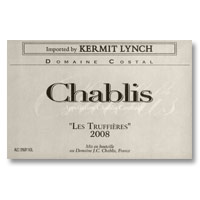
2008 Domaine Costal Les Truffières, Chablis

For generations of American wine drinkers, the term Chablis means insipid, slightly sweet white wine that comes from the Central Valley of California. As a wine educator, this is painful, but I can’t blame the wine drinking populace. No, I level the blame with the ATF, and now the TTB, the organizations responsible for promulgating the wine labeling requirements for wine in the US. Many years ago, in their infinite wisdom, the ATF decided to create a set of “generic terms” that could be used on wine labels to help “name” and “market” wines made in the US. Chablis is one such term and it is unfortunate, especially since the French have sought legal protection for most of their more famous AOC’s.

What I want folks to understand is that official French Chablis is Chardonnay in its purest form. Irrigation other than the moisture Mother Nature provides is illegal for AOC wines. This means that the vines in most French vineyards grow deep into the sub-soil searching for precious water. The depth of these root systems allows the vine to take up a lot of complex minerality from the soil. In the case of Chablis the sub-soil is prehistoric sea shells, which produce a distinctly chalky note. Arguably this is one reason that Chablis is the near-perfect accompaniment to oysters…

The Domaine Costal, another partnership involving Kermit Lynch is stunning Chablis. The other stunning factor is the price – average retail of $29.99 per bottle is a remarkable value. If you prefer your Chardonnay as an expression of the fruit and not winemaking techniques, then this is a wine for you!

My tasting note:

Green apple and mineral nose – clean with just a tiny hint of oak. Medium-bodied with moderate acidity – rich – well balanced. Tart, citrus palate with lemon, apple and pear notes. Long finish with a purity of fruit – delightful! Drinking well now and should improve with another 5 to 7 years in bottle. A good value in Chablis!

Cheers!

The Racquet Club Cocktail

Folks who have taken part in my Art of the Cocktail class are aware of my feelings about the Martini. In a word, my feelings borrow from the movie Highlander: “There can be only one!” Well, perhaps this is not entirely true. As a purest, I believe that the ONLY base spirit permitted in a Martini is GIN. Not Vodka, not Apple Schnapps, not anything but Gin. Given that, I will certainly entertain the multitude of variations that masquerade as Martinis, even if their name bears no reference or similarity to the original, welcome the Hoffman House, the Vesper and the Racquet Club Cocktail. However, the essential formula must contain elements of the original cocktail: Gin and Dry Vermouth. From there the palate is endless and can include additional spirits, different garnishes, a range of bitters and even neat versus on-the-rocks.

Before I get to the subject at hand, I must digress to another aspect of this much bastardized cocktail – the concept of the “dry” martini. In its original form, the balance between Gin and Vermouth was more evenly matched. Heck, the original drink was likely created with a version of Gin that possessed a sweeter, more aromatic profile – Old Tom Gin. To me the perfect cocktail is about BALANCE – that quality wherein the individual flavors and tastes of the various component parts marry into a blissful concoction of smoothness and pleasure. The bar tenders of old knew this and were largely forced to become masters of mixology primarily as a result of sub-standard base spirits. Old pros knew that to keep the crowds coming in for more libations, the drinks needed to be spirituous and alluring.

At some point the Martini took a turn towards manliness. Somehow, returning veterans from the last great conflict (that would be WWII for the very young among us) felt that slaking their thirst with glasses of chilled Gin was the most appropriate means to dull the painful memories of a war-weary nation. Vodka showed up with the Moscow Mule and the Screwdriver and it would seem that the concept of the balanced cocktail flew out the window forever. Adages like “pass the Vermouth over the Gin/Vodka,” or “turn towards France when you shake the Gin/Vodka with ice” became the hallmarks of a drinking nation.

Fortunately we are seeing the errors of our ways. The recent resurgence in classic cocktail drinking is bringing back the concept of balanced libations. A perfect example is the previously mentioned Racquet Club Cocktail. In this month’s Imbibe magazine, Mr. David Wonderich writes about this wonderful pre-Twentieth Century treat. What drew me to the cocktail was not the 2-to-1 ratio of Gin to Dry Vermouth, but instead the addition of Crème de Cacao to the recipe. I found that when I crafted the cocktail with Old Tom Gin and a healthy bar spoon of C-d-C, it was remarkably smooth with just a whisper of dark chocolate on the finish. Ice cold, the drink was near perfect for taking the edge off a long day. If you like the Vesper, I heartily recommend that you roll a Racquet Club Cocktail and compare.


The Racquet Club Cocktail

2 oz. Gin (I prefer Old Tom)

1 oz. Dry Vermouth (I prefer Dolin)

1 bar spoon of Crème de Cacao

3 dashes Orange Bitters

Mix all ingredients and shake vigorously with crushed ice. Strain into a chilled cocktail glass and garnish with a lemon twist.

Cheers!

2010 Torres Viña Esmeralda, Cataluña, Spain

In my History of Italy, France and Spain in Ten Glasses classes I talk about the important contributions that the Muslims made to the history of wine and spirits. For openers, the Muslim invaders brought with them the art and science of distillation, which they used for producing perfumes and medicinal elixirs. It took distillation in the hands of Christian monks to produce a different elixir, one known as the “water of life,” or Whisky. Muslims also brought with them a better understanding of astronomy and the impact of planetary motion on agriculture, which in turn improved the growing of crops, especially grapes. Lastly, the Muslims brought with them the vine – specifically vines of the Muscat grape. Despite the conflict that has raged between Christians, Jews and Muslims over the last 2,000+ years, I think we wine and spirits lovers should take a moment to say thanks.

So I’m not waxing poet about world peace, but I am going to rave about a lovely wine from Spain – the 2010 Torres Viña Esmeralda, a terrific blend of Muscat (85%) and Gewurztraminer (15%), giving the wine an exceptionally exotic nose and palate. A “light” wine at 11.5% alcohol (I seem to recall when a “light” wine contained 5% – 7% alcohol), the forward fruit provides the teasing impression of sweetness, but the finish is crisp and food-friendly. At an average retail price of $13.99 per bottle, you really can’t go wrong.

My tasting note:

Perfumed, floral nose with honeysuckle, lychee and pear hints – gorgeous! Light-bodied with moderate acidity – crisp and clean – well balanced. Citrus and exotic fruit palate – lemon, apricot and papaya notes – smooth. Moderate length – light and refreshing. Drinking well – not for aging, although the screw cap will keep the wine fresh for a while.

Perfect for the Thanksgiving table!

Cheers!

2007 Tolaini Valdisanti, Toscana

Super Tuscan… Most people who have drunk wine long enough know the term… For those who don’t, the term was coined back in the late 70’s, early 80’s and it describes a particular type of wine from Italy’s Tuscany region – the home of one of the world’s most well – known wines – Chianti. So where does this term come from? Well, as I have related to so many of my classes, throughout the 60’s and early 70’s the wines of Chianti were universally considered some of the most awful wine on the planet. Rampant over planting and production, combined with less-than-stellar wine making combined to produce wine that was thin, bitter and just dreadful. Even pizza was embarrassed to have to share the limelight with this inferior plonk.

With time, younger wine makers, and a few traditionalists started a movement to make Chianti a wine worthy of its name. However, during this renaissance of wine, certain producers felt that the problem was more deeply-rooted – fundamentally the laws governing production in Chianti needed to be “updated” to harness the true potential of wine making in the region. Well, updating wine laws in Italy is tantamount to changing the laws of Roman Catholicism – I think it involves flying pigs, or a certain subterranean region freezing over… Get the picture? So, a few enterprising folks decided to make some wine that was truly the best wine they could make, literally “Super Tuscan” wine. Of course, the wine did not conform to wine law standards and therefore had to be delimited as plain old Vino da Tavola wine, but to wine connoisseurs around the globe, these were wines worth noticing.

The bottles commanded extraordinary prices, which were shocking for wines that were no more than “table wines,” but the quality and character of the wines spoke volumes about what these wines were really worth. Over time the wine laws would adapt to recognize these wines for what they are – non-traditional Italian wines of the highest quality. Eventually the term Indicazione Geografica Typica Toscana would supplant the term Vino da Tavola, and a new hot region was born…

In Europe vintages are much more important than they are in the US. Where California basks in near perfect growing conditions, Europe almost always has to light candles for Mother Nature to shine a little beneficial sunshine on their oft suffering vineyards. Lately, though Europe has enjoyed a few really terrific vintages – 2005, 2007 and now 2009. I have tasted a lot of wine from all three vintages and they are each distinct. The 2005 vintage is big – wines with lots of fruit and lots of tannin – near endless aging potential… The 2007 vintage produced wines with good structure and balance, but unlike 2005, the 2007 wines tasted a bit more integrated and mature. The 2009 vintage is like 2005 on steroids – bigger, fuller in-your-face wines that seem endless…

Here we have a really fantastic wine – from the 2007 vintage the wine has a smoothness and maturity that is welcoming. The region is Toscana and you can tell that while Sangiovese plays a part in the wine, the dominant grapes are non-indigenous varietals – Cabernet Sauvignon and Cabernet Franc… A Parker 90+ wine, which I could care less about, but some folks will take as validation – small quantities and somewhat expensive – $29.99 average retail per bottle – high value in my book…

 My tasting note:

Ripe, jammy nose with blackberry, raspberry, lilac and tar hints – stunning. Full-bodied with moderate acidity and firm, dry tannin – good balance. Sour cherry palate with truffle, saddle and red berry notes – impressive. Long finish – smooth with layers of complexity – spice, cocoa and vanilla bean. Drinking well and should improve with 7 to 10 years in the bottle. Good value.

Here’s to breaking the rules and producing the best wine possible!

Cheers!