Category Archives: Wines

2013 G.D. Vajra Albe Barolo

23 Friday Feb 2018

Posted by musingsonthevine in Wines

≈ Leave a comment

GDVajraBarolo2013

As promised, here is another exceptional 2013 Barolo. The wines of G.D. Vajra are truly artisanal, crafted from some of the best grapes in Barolo. The wines also represent a tremendous value when compared to Barolo of similar quality.

G.D. Vajra was started by Aldo and Milena Vajra in 1972 and produced minuscule quantities of various Piemontese wines. The grapes were sourced from vineyards planted by Aldo’s father in 1947. Originally, the fruit was sold in bulk to negociants, but in 1978 that all changed, when Aldo produced the first serious commercial bottling bearing the family name.

Today, the family owns approximately 100 acres of vineyards in Barolo, consisting of holdings in Fossati, Coste de Vergne, and La Volta. The winery is very traditional and macerates its wines for 20 to 30 days depending on the vintage. The wines are typically matured in large neutral Slavonian casks. Stylistically, the wines possess finesse and elegance and are more refined on the palate.

The Albe is a very seductive wine, with a highly perfumed nose and ripe cherry aromas. Well-balanced with moderate acidity and well integrated tannin, the wine has a tight fruit core and a long, complex finish. Drinking well, but should benefit from many more years of bottle aging.

In the Boston area the wine is retailing for $39.99 per bottle, pre-discount, which is an outrageous value for wine of this quality. Given the aging potential of the wine, the value only increases.

Cheers!

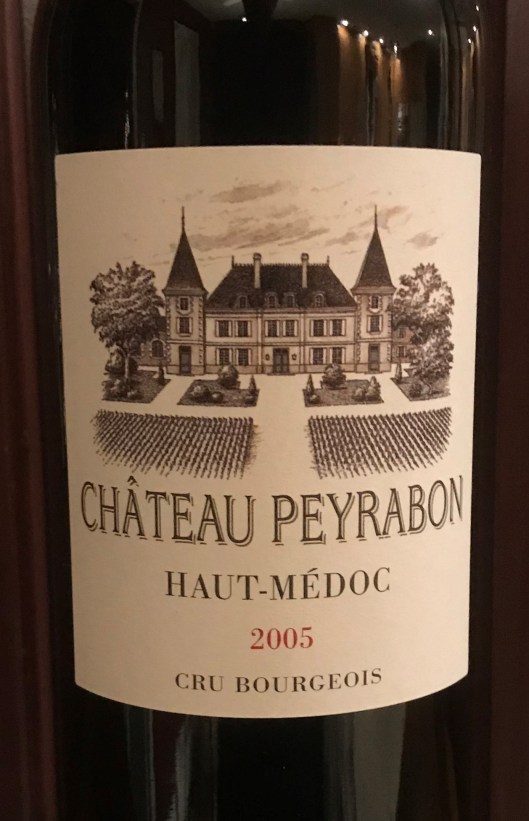
2005 Chateau Peyrabon Haut Medoc

15 Thursday Feb 2018

Posted by musingsonthevine in Wines

≈ Leave a comment

Peyrabon

Chateau Peyrabon is a cru bourgeois property in the appellation of Haut Medoc in Bordeaux. The chateau has vineyards in both Haut Medoc and Pauillac, although the Haut Medoc vineyard is one of the largest holdings in that region at over 70 acres. The location of the parcel is several miles inland from the Gironde estuary, lying within a mile of the Pauillac commune. The gravelly soil imparts classic “Left Bank” minerality to the wine.

The chateau was purchased by noted Bordeaux merchant Patrick Bernard in 1998 and has been the recipient of generous investments to improve quality and production. The results are clearly evident in greatly improved scores for wines judged after 1998. Peyrabon is not without a bit of controversy. Back when the original Medoc Chateau were classified in 1855, Chateau Peyrabon was excluded from the list, despite commanding prices that were commensurate with other listed properties (historic selling price was the primary criteria for inclusion in the classification). As we all know, the classification has withstood many challenges, relenting only once to elevate Chateau Mouton Rothschild from second to first growth in 1973. Peyrabon’s 14 year challenge was ultimately unsuccessful, but the chateau was able to get in on the cru bourgeois extension of the classification, so there is some acknowledgement of the historic quality and importance of the property.

As a “Left Bank” Bordeaux, the wine is typically a blend of 50% Cabernet Sauvignon, 27% Merlot and 23% Cabernet Franc.

The 2005 vintage in Bordeaux was very highly-touted, coming after several weaker vintages. As such, the futures market was very active with some of the highest prices recorded to date. In addition, many top-rated chateaux sold out during the futures campaign, meaning that many wine lovers would only get to acquire their favorite wines at full release price, assuming they could get them at all.

The 2005 Peyrabon is classic “Left Bank” Bordeaux with lots of minerality and savory fruit notes. At thirteen years old, the wine is showing great maturity with evolved bottle-aged complexity. The wine is still a deep ruby red color, possessing an almost obscure robe with a hint of brick on the disc. On the nose, strong cherry fruit is evident with hints of menthol, dried herb and wet stone – classic. On the palate the wine is very well-balanced with an elegant structure, moderate acidity and well-integrated tannin. Cherry fruit is again evident, dense but not jammy. The finish is long with unfolding layers of complexity that open with time in the glass. The wine is drinking well and will likely continue to improve for another 5 to 7 years in the bottle.

Availability is another matter. We’re blogging about the wine because it was recently offered in the Boston market at an unbelievable price. The thirty cases that were offered sold out within an hour. That said, the wine is a spectacular value and worthy of coverage, if for no other reason than to put it on people’s radar screen in the event more shows up at some point. As a point of reference – the wine typically sells for between $28 and $30 per bottle – the offering that I reference had it on sale for $19.99 net per bottle. Now you can understand why it sold out in an hour.

This was the first time I experienced Peyrabon – based on how this vintage showed, it will not be my last… Looking forward to tasting some other noted vintages like 2009, 2010, 2012, 2015 and 2016.


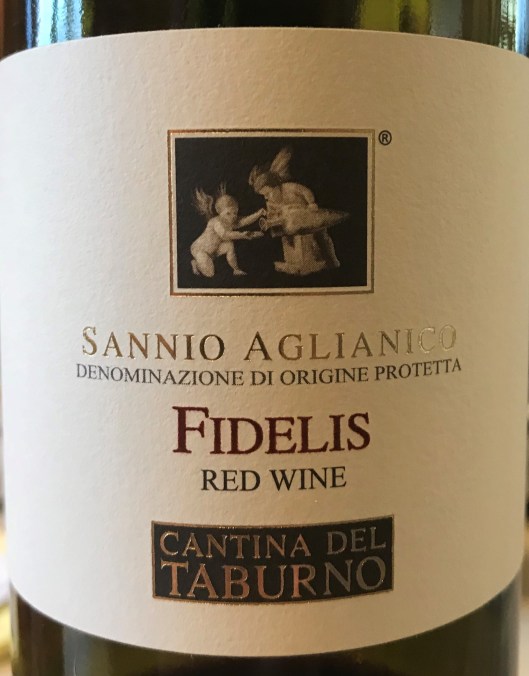
2013 Cantina del Taburno Fidelis Sannio Aglianico DOP

13 Tuesday Feb 2018

Posted by musingsonthevine in Wines

≈ Leave a comment


TaburnoSannioAglianico

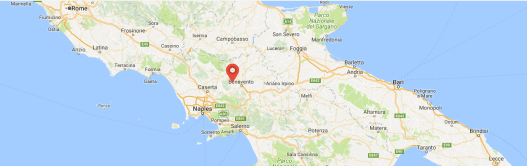
Cantina del Taburno was built in 1972 in the town of Foglianise on the slopes of Mount Taburno. The winery is owned by the “Consorzio Agrario di Benevento” (Agricultural Consortium of Benevento), which was founded in 1901 to promote development of agriculture in the Sannio region of Italy.

The winery uses grapes harvest from vineyards (approximately 1,500 acres) spread among the towns of Foglianise, Torrecuso, Vitulano, Campoli del Monte Taburno, Castelpoto, Apollosa, Bonea, Montesarchio, Ponte, Tocco Caudio, Paupisi and Benevento. Many factors contribute to the exceptional quality of the grapes, including soil (a mix of clay and calcareous), climate (mild Winters with Fall and Spring rainfall and warm, dry Summers) and the slope-side positioning of the vineyards. The consortium has also been very careful to ensure that the most modern wine-making techniques are employed at the winery.

TaburnoMap

As a consortium-owned facility, the winery is used by approximately 300 grape growers. The primary red grape vinified at the winery is Aglianico del Sannio, with other minor red varietals, such as Piedirosso and Sciascinoso present. The primary white grape vinified is Falanghina, with other minor white varietals, such as Coda di Volpe, Greco and Fiano present. Despite the breadth of wines produced, one of the most-popular wines is the Fidelis.

The Fidelis is a blend of 90% Aglianico along with Sangiovese and Merlot. The vineyards are located on slopes approximately 1,000 – 1,800 feet above sea-level and have a southeast and northeast exposure. The soils, as previously noted are clay and calcareous, which add a distinctive minerality to the wine. Vine density is limited to no more than 1,500 per acre with a Guyot trellis system to promote maximum sun absorption. Harvesting is accomplished entirely by hand with only the ripest clusters being chosen and used in the must. Extended maceration to improve color and phenolic saturation, along with full malolactic fermentation to promote roundness, are employed in the winery. The wine is then aged in second and third use oak barriques to smooth and temper the wine.

The wine is a delight on the palate with vibrant, dark fruit flavors and pretty floral notes. Well-balanced with firm acidity and great structure, the wine makes for a very pleasant accompaniment to a meal. Not for long term aging, but the wine will gain complexity with a few more years in bottle.

The wine is a great value, with an average cost of $17.99/bottle. In some markets, the wine is certainly priced to move at $10.99/bottle, which represents a fantastic everyday wine. Despite the bargain price, the high-quality of the grapes and production are clearly in evidence in the wine.

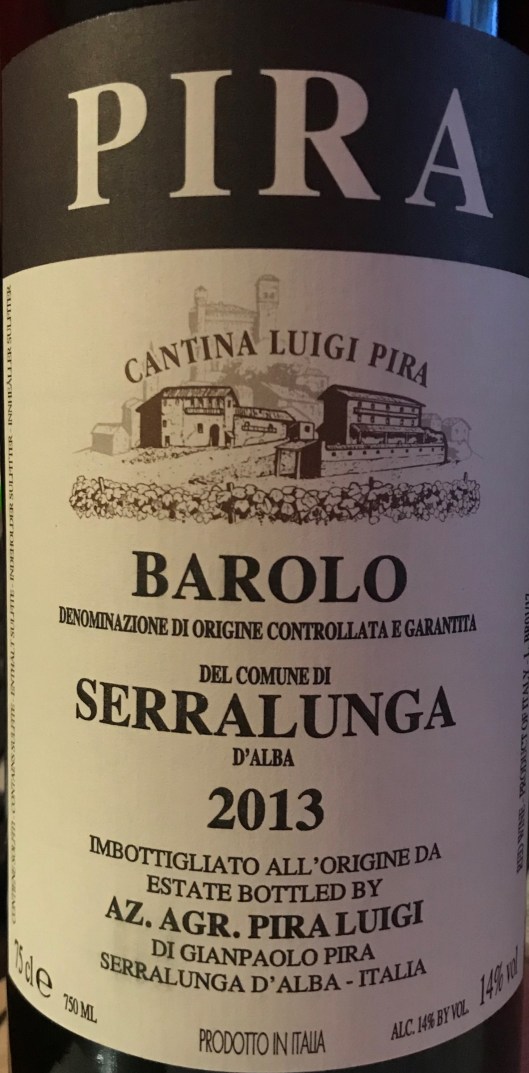
2013 Cantina Luigi Pira Serralunga Barolo

05 Monday Feb 2018

Posted by musingsonthevine in Wines

≈ Leave a comment

PiraSerralungaBarolo2013

Barolo is known as the “king” of Italian wine, heralding an elegance and nobility that is fitting of royalty. Produced in the region of Piedmont from Nebbiolo grapes, the wines are characteristically shy, taking many years to fully bloom. Even with more than twenty years of age, Barolo can be tight and reserved, but with coaxing the wines give forth layers of delicate complexity and nuance.

As a true student of wine, I have been an avid follower of Barolo since the beginning of my wine journey thirty-five years ago. I truly became a fan with the 1997 vintage, within which there seemed to be a limitless collection of amazing Barolo. Having acquired and laid-down many producers from this pivotal vintage, the wines are showing incredible grace and elegance with a twenty-year patina that is like no other wine.

Prices escalated as Barolo racked up successive vintages of stunning wines. It was clear that a favored region was becoming inaccessible.

And then the 2013 vintage arrived. Heralded as one of the best vintages of the decade, the wines are coming to market with all the characteristics of the famed 1997 vintage, and surprisingly in some cases the prices are actually quite reasonable.

I have tasted through most of the major producers and will be highlighting those that I have chosen to purchase over the next few months. The good news is that if you are lucky enough to grab some of these wines, you will not be disappointed. Their aging potential seems as prodigious as the wines of 1997, so keeping them around is an admirable end game. The bad news is that in many cases the quantities of some of these wines is limited, so finding them may be a challenge. Especially finding them at reasonable prices. Like any supply-and-demand market, as supply dwindles, demand rises and so does price.

The Cantina Luigi Pira is a Barolo that is new to me. The winery was opened in the 1950’s, first supplying grapes and then primarily bulk wines through the 1980’s. In the 1990’s, Pira began to stress quality over quantity and in 1993 they produced their first Barolo. Later in the decade the winery acquired the three Serralunga plots that provide the Nebbiolo for its single vineyard Barolo wines: Rionda, Marenca and Margheria.

The estate now farms 12 hectares (approximately 29 acres) of vineyards planted mostly to Nebbiolo, with smaller plantings of Dolcetto and Barbera. Cantina Pira Luigi avoids the use of chemicals in the vineyard, instead favoring natural farming practices that emphasize low yields. Production is relatively small with just 5000 cases made annually.

The wine featured here is their basic Serralunga Barolo, made from grapes obtained from the “Le Rivette” zone located in the lower parts of the Marenca and Margheria vineyards. Like a second label wine from a fine Bordeaux Chateau, the essence of quality present in the “first growth” wines is clearly in evidence. The calcareous-clay soil provides great structure and terrior to the wine.

The wine is showing very well now, with a vibrant nose featuring cherry, dried herbs, mineral and light floral hints. Very pretty. Well-balanced with firm tannin and moderate acidity. The palate is dense and dark with tightly-packed fruit, exhibiting gamey, savory notes and a hint of allspice. The finish is very long and somewhat closed. With time, the aftertaste blossoms with layers of wonderful complexity. The wine should improve with time in the bottle, perhaps ten years or more.

I picked this wine up at the Medfield Wine Shoppe a few weeks ago. It was priced very reasonably at $39.99/bottle before any case discounts. I can’t say if they have anymore at that price, or if they have anymore of the wine period, but I can say that if you enjoy Barolo and you want a wine that can age gracefully for at least the next ten years, then this wine is an extraordinary value worthy of a phone call…

Cheers!

2015 Emporium Appassimento Rosso Salento IGT

29 Monday Jan 2018

Posted by musingsonthevine in Wines

≈ Leave a comment

An unusual Italian offering… Vino Passito from Salento… what is Vino Passito from Salento? Well, Vino Passito is a style of wine, also known as Straw Wine, which involves the drying of grapes on straw mats to concentrate and “raisinate” the grapes before fermentation. The byproduct of the process is a heightened complexity and intensity in the resulting wine. In the case of this wine, the process involves late harvesting the finest grapes after they have been allowed to dry on the vine. Not quite traditional, because the process does illicit similar results.

Salento is a region in Puglia in Southern Italy known for full-throttle reds made from the native Primitivo and Negroamaro grapes. This wine is a 50/50 blend and the late harvest process showcases the intensity of these two varieties.

My impressions… Lush, fruity nose with loads of cooked fruit and exotic spice. Broad palate with jammy, dark flavors. Well-balanced and smooth with soft, integrated tannins. Long finish with layers of unfolding complexity. Drinking superbly with moderate aging potential. Simply wonderful.

The other good news? This wine is a fantastic value at an average price in the Boston-area of $14.99/ per bottle pre-discount.

2015 Domaine Anne Gros – Jean-Paul Tollot La 50/50 Cotes du Brian

27 Saturday Jan 2018

Posted by musingsonthevine in Wines

≈ Leave a comment

La5050GrosTollot

A charming, full-throttle wine from Minervois, although because of varietal requirements the wine can only carry a “table wine” designation. The product of a 50-50 partnership between two eminent Burgundian producers – Anne Gros and Jean-Paul Tollot. Both produce infinitesimally small amounts of Cote d’Or Burgundy from some of the most sought-after plots of soil, which are testaments to their skill as winemakers. In choosing to go south into the Languedoc, the pair bring their Burgundian skills to bear on a fabulous site of old vines in Minervois – 35 year old Carignan, 60 year old Cinsault, 22 year old Grenache, and some younger Syrah, each go into the cepage of this wine.

As previously noted, although the grapes all come from old vines in Minervois, the wine is only entitled to a “Vin de Table” designation because the Minervois AOC requires at least 40% Carignan. However, Anne prefers a balance of more or less equal amounts of Carignan, Cinsault and Grenache with some Syrah rounding out the blend. Like Marilisa Allegrini in Valpolicella choosing to delimit their Palazzo della Torre from Valpolicella Classico to IGT Verona many years ago, Anne prefers delimiting to IGP Pays de Herault, rather than make an inferior blend tied to AOC Minervois. This kind of bold decision-making in the face of global marketing pressure is why the wines of Anne Gros are so fabulous.

The wine itself is terrific, with an explosive nose filled with fresh cherry, black berry and rose petal notes. Stainless-steel fermentation preserves the freshness and purity of the fruit, which sings boldly on the palate. Dense and juicy with great acidic balance, the wine is clearly at home with food. And yet, the subliminal complexity of exotic spices, wet stone and fresh herbs offer contemplative rewards. Drinking exceptionally well now, the wine should mature nicely over the next 2 to 3 years, but this is not a wine for aging.

In the greater-Boston area the wine is represented by Arborway Imports and was available in limited quantities at Berman’s in Lexington, MA. Regular, pre-discount pricing is $24.99/per bottle… the wine was on sale at $15.99/per bottle in case quantities… If there is interest, I strongly urge acting FAST.


Old Bordeaux

09 Sunday Jul 2017

Posted by musingsonthevine in Wine Events, Wines

≈ Leave a comment

In the thirty-five or so years that I have been tasting, exploring and enjoying wine I have been extremely fortunate. I have had gracious and generous teachers, men and women who have opened their minds, their hearts and their cellars for my benefit. I like to think that their sharing was a reward for my passion and enthusiasm about this magical elixir, which has been with us for the last six thousand years, or more.
OldBFLight

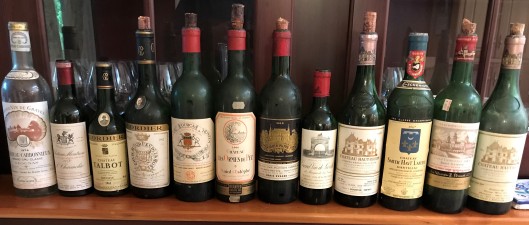
Recently I was privy to a once in a life time opportunity, the tasting of twelve incredible Bordeaux wines dating back to 1953, including many from 1961, 1962, 1966, 1967 and 1974. The flight was simply the most incredible collection of wines, all but one showing Bordeaux’s eminent potential for greatness.

The flight was as follows:
OldB1974Carbonieux

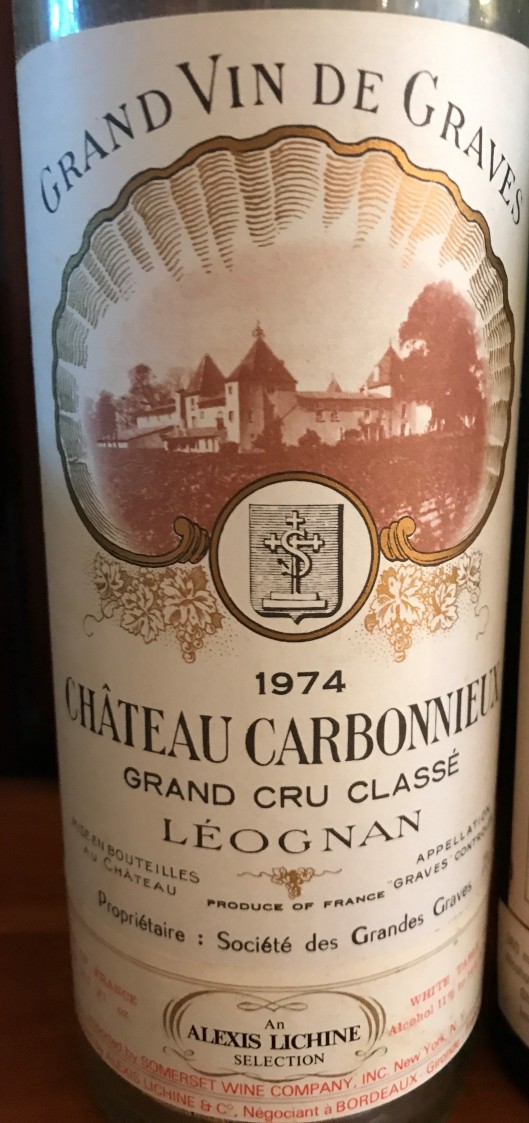
1974 Carbonnieux Blanc, Graves, Pessac-Léognan

Truly noteworthy. For a white wine with 43 years of age, it was showing beautifully. Deep amber in color with a light, almost floral nose. As it spent time in the glass, the bouquet opened to vanilla, butterscotch, pear and custard. On the palate, the wine was expectantly dry, very light-bodied with moderate acidity. With more time, the wine began to show an Amontillado-like character with layers of complexity on the finish. Clearly builds a case for the aging potential of white Graves.
OldB1953Montrose

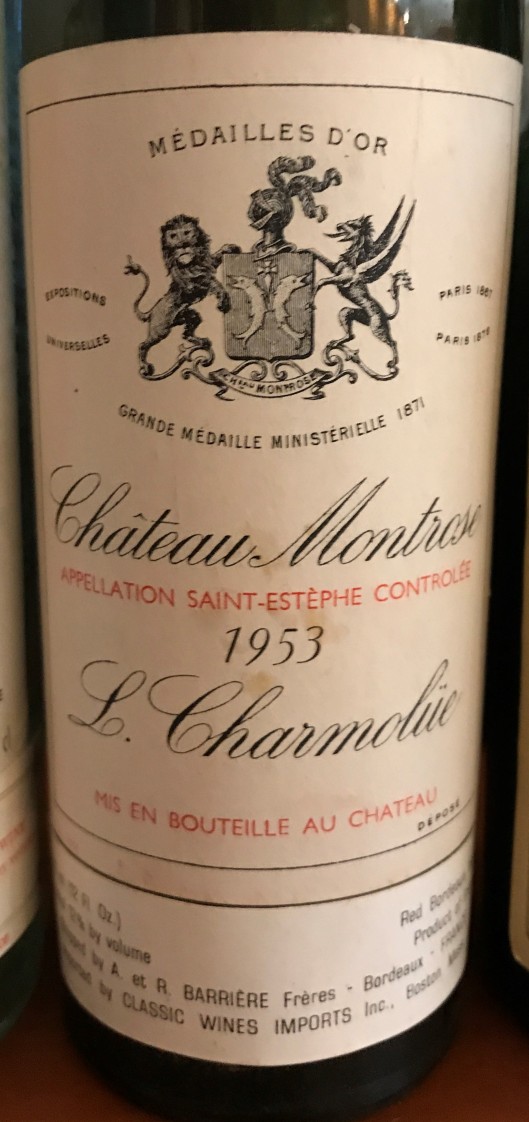
1953 Montrose, St. Estèphe

Marvelous. Vibrant nose with cooked fruit, saddle leather, cedar and mineral hints. Medium-bodied, very well-balanced with almost no tannin. Soft and earthy on the palate, with gamey, roasted meat and mushroom notes. Very long, complex finish. Hints of red fruit were an amazing testament to the aging potential of this wine. To have any trace of freshness at 64 years old is simply amazing. The fact that the wine was a 375mL split is even more incredible.
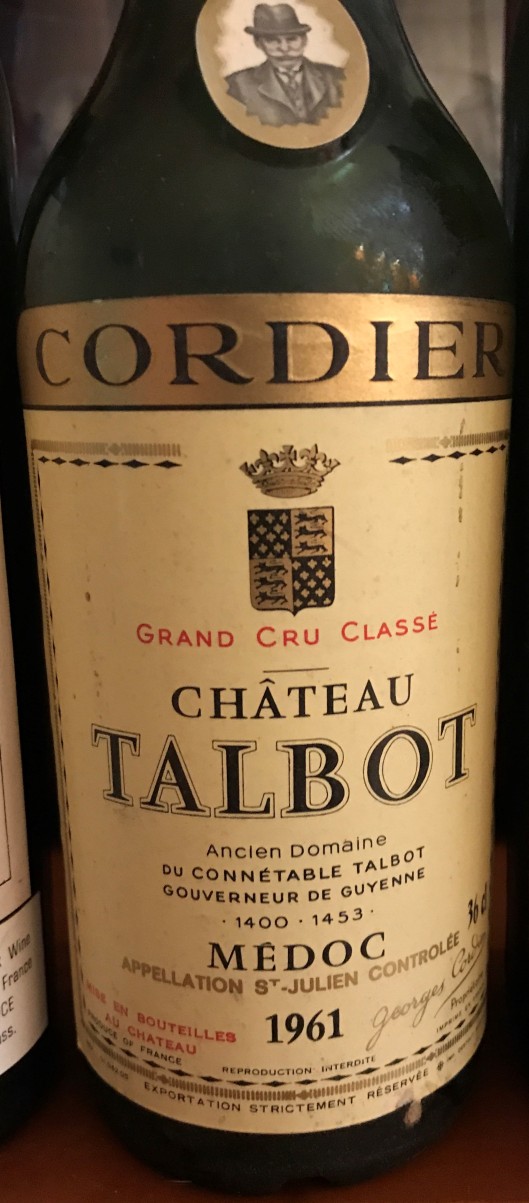
OldB1961Talbot

1961 Talbot, Saint-Julien

A bit disappointing. Brownish tint with a hint of ascetic acid on the nose. Sweet cooked fruit, prunes. Sherry-like with a strong Oloroso nature. Burnt orange rind on the palate with forward acidity. In this case, the 375mL format is showing its age.
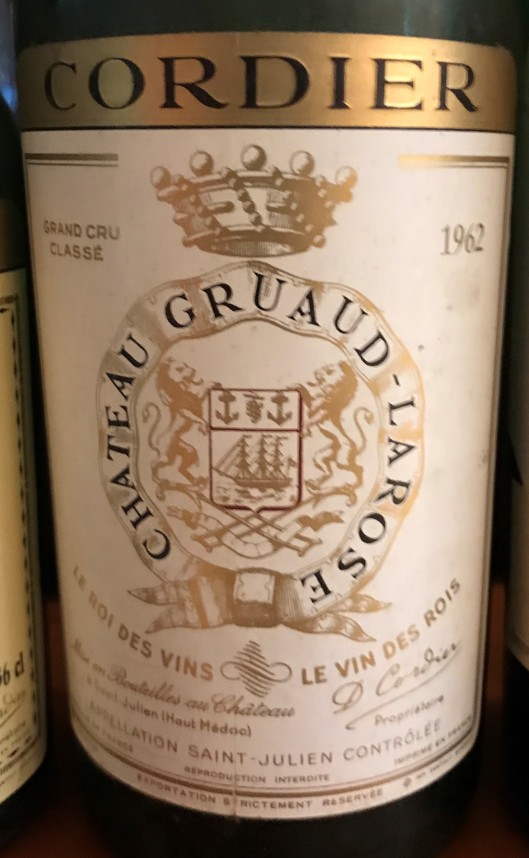
OldB1962Gruaud

1962 Gruaud Larose, Saint-Julien

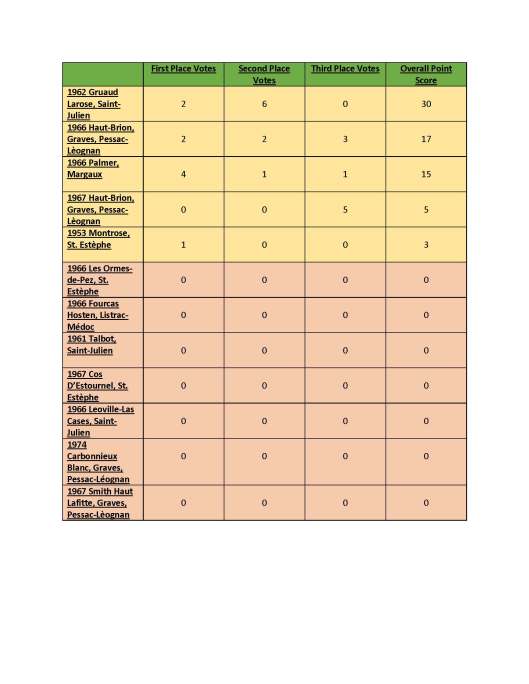
The overwhelming favorite of the flight, by weighted score. Brickish tint with a strong earthy nose. Roasted game, cooked fruit, menthol, saddle and cedar hints abound. Charming. Medium-to-full-bodied with great mid-palate weight. Some acid and a sour cherry tartness. Dark fruit with an evolving, ultra-complex finish. Absolutely wonderful.
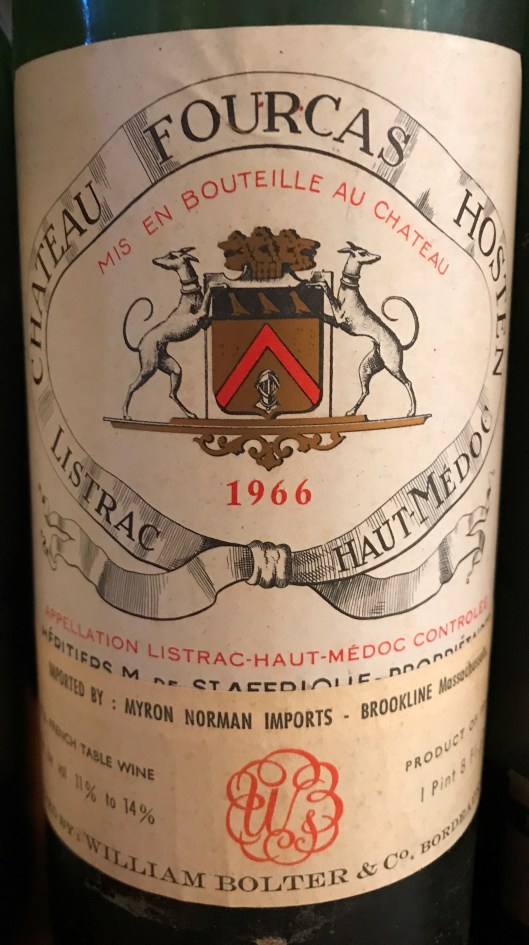
OldB1966Fourcas

1966 Fourcas Hosten, Listrac-Médoc

Brickish with a faded, garnet robe. Peppery nose with dark, cooked fruit hints. Medium-bodied but very dry on the palate. Tart with briarwood notes. Long finish, but a little abrasive.
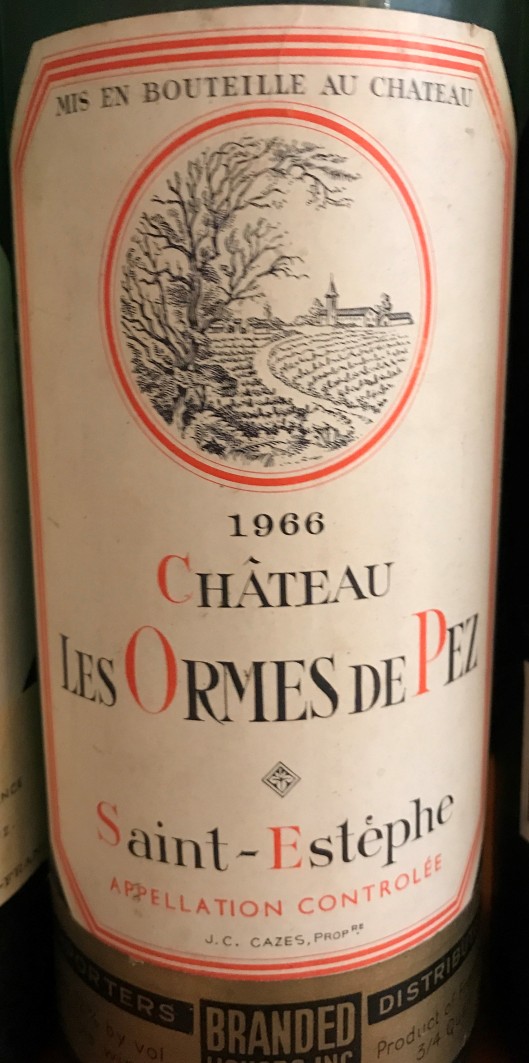
OldB1966LesOrmes

1966 Les Ormes-de-Pez, St. Estèphe

Briskish but with a blood-red robe. Cooked fruit nose with prune, saddle leather and cedar hints. Medium-bodied with moderate acidity and surprisingly firm tannin. Dry and lacking mid-palate weight. Dark fruit and anise on the finish.
OldB1966Palmer

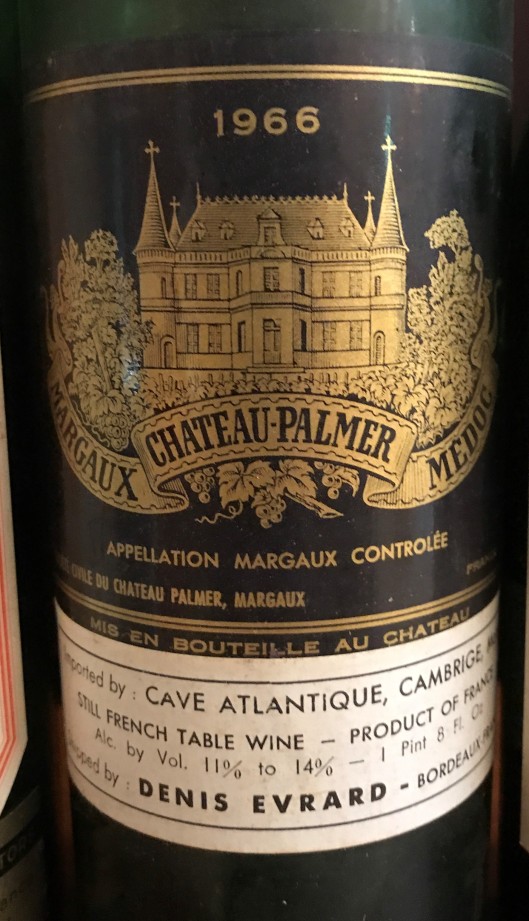
1966 Palmer, Margaux

The overwhelming favorite of the flight, by first place votes. Brickish with a fig-like nose with stewed fruit, prunes, saddle leather and cedar. Medium-bodied with good mid-palate weight. Some acidity and firm tannin. Dried fruit and roasted game on the finish that is almost endless. Awesome vibrancy for 51 years old.
OldB1966LasCases

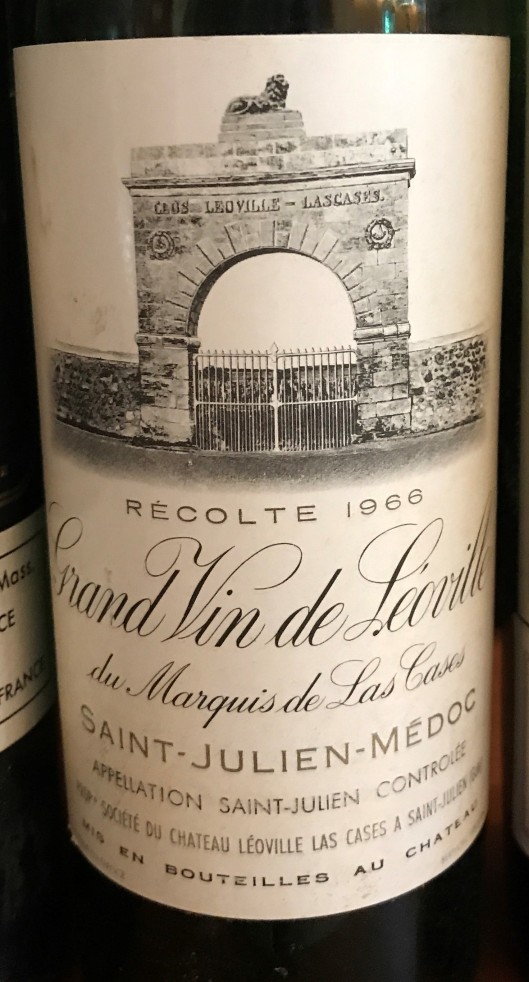
1966 Leoville-Las Cases, Saint-Julien

A bit disappointing. Brickish with faded garnet robe. Tired nose with saddle leather and cedar hints. Medium-bodied with firm acidity. Very dry. Tart. The 375mL format did not help this wine age. Very tired overall.
OldB1966HautBrion

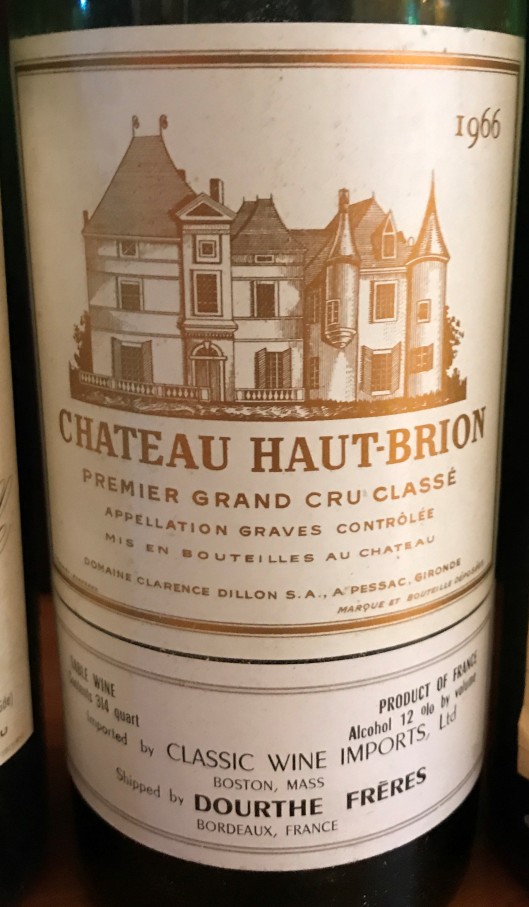
1966 Haut-Brion, Graves, Pessac-Lèognan

Second in terms of weighted score, as well as first place votes. Brickish but with a dark, opaque robe. Dark fruited nose with black cherry/blackberry jam hints. Medium-to-full-bodied with loads of dark fruit. Lovely. Gamey, roasted meat palate with smoky notes. Long finish with strong mineral/granitic notes. Another wine of incredible vibrancy for 51 years old.
OldB1967Smith

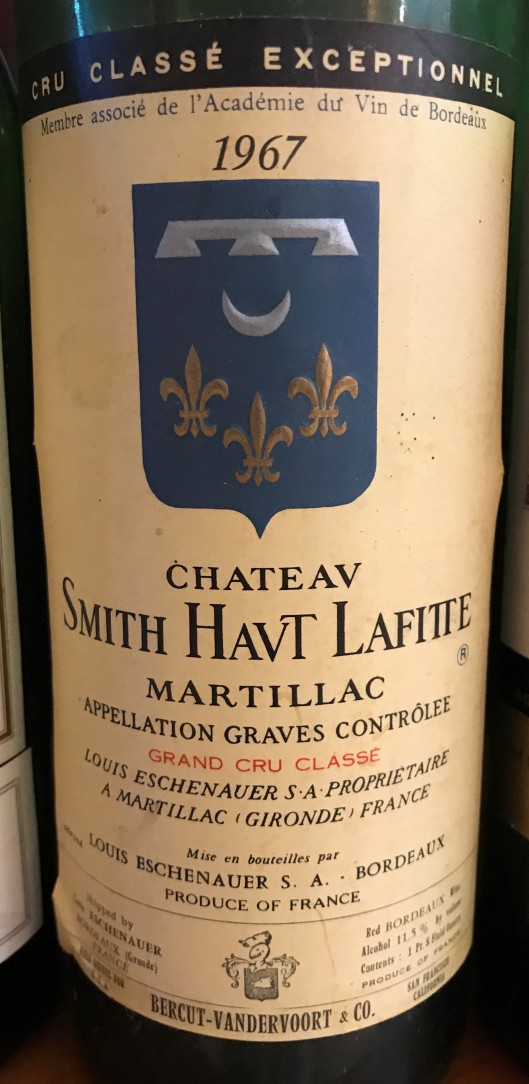
1967 Smith Haut Lafitte, Graves, Pessac-Lèognan

Unfortunately, the cork had failed and the wine was pure vinegar.
OldB1967Cos

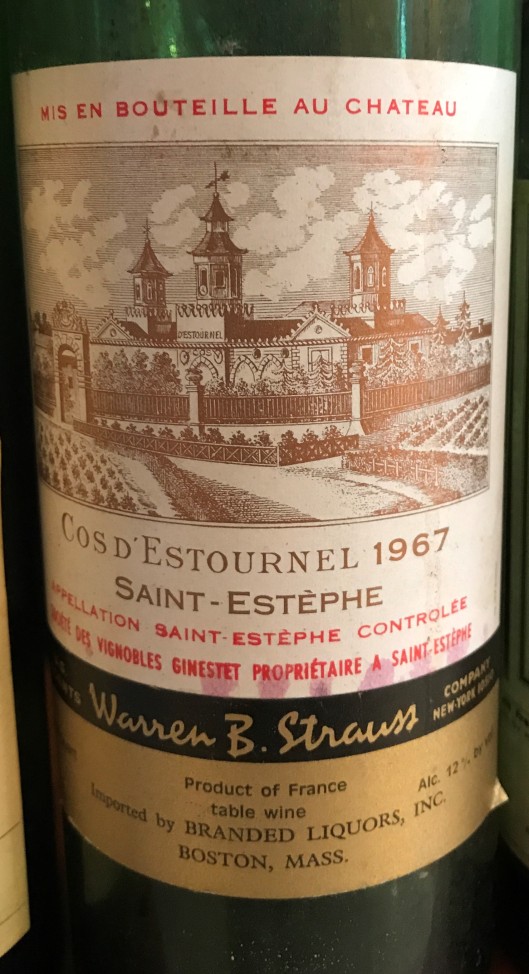
1967 Cos D’Estournel, St. Estèphe

Very disappointing. Light brickish, faded rose. Bright nose with some cherry fruit hints. Very light-bodied with no tannin and firm acidity. Tasting more like an old Burgundy than Bordeaux with dried red berry notes.
OldB1967HautBrion

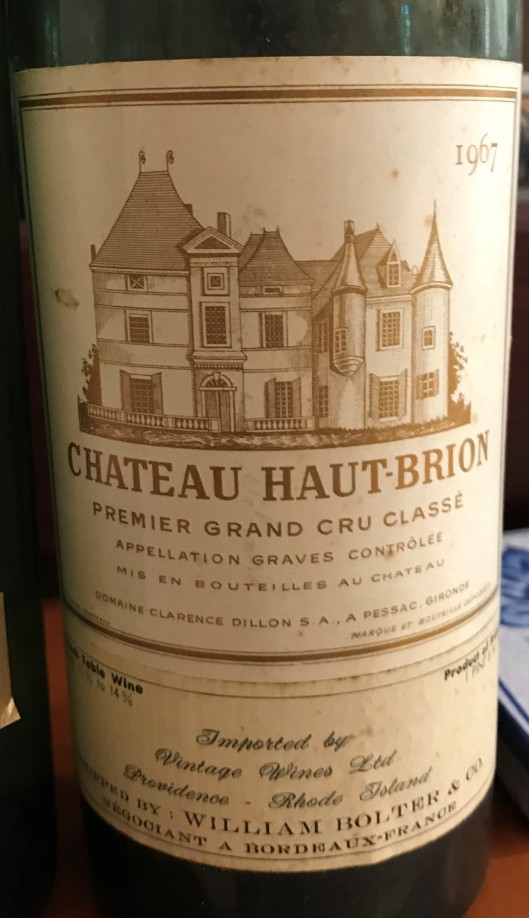
1967 Haut-Brion, Graves, Pessac-Lèognan

A solid wine coming in third by the number of third place votes. Deep coloration with a faded rose tint on the disk. Cooked fruit nose. Meaty with saddle leather, cedar and smoky hints. Medium-to-full-bodied with firm tannin and moderate acidity. Great mid-palate weight with dark fruit notes. Long finish, a bit muddled.
OldBordeauxTableA few notes about the vintages.

1953 Not deemed to be a spectacular vintage. The growing season was considered hot, which developed strong sugar levels. September rains pushed the harvest out far enough to allow for added hangtime, which is one reason why the wines from 1953 are showing such great potential.

1961 Considered a legendary vintage with many wines still drinking exceptionally well.

1962 Classic shadow vintage, coming on the heels of the legendary 1961 vintage. Many wines are showing great potential, not unlike 1983 and 1996 wines.

1966 A very strong vintage with many wines, like the Palmer and Haut-Brion above showing an almost youthful vigor.

1967 Deemed a minor vintage. Some wines continue to show well, but most are tired and were likely at their peak back in the late 1990’s.

1974 A very weak vintage with a few standouts, but overall very poor quality and aging potential.

Tommasi Family Estates

22 Thursday Jun 2017

Posted by musingsonthevine in Wines

≈ Leave a comment

One of the first times I experienced the magic of Amarone della Valpolicella Classico was with the wines of Tommasi. I have since grown incredibly fond of Amarone in general, placing the region easily in my top three.

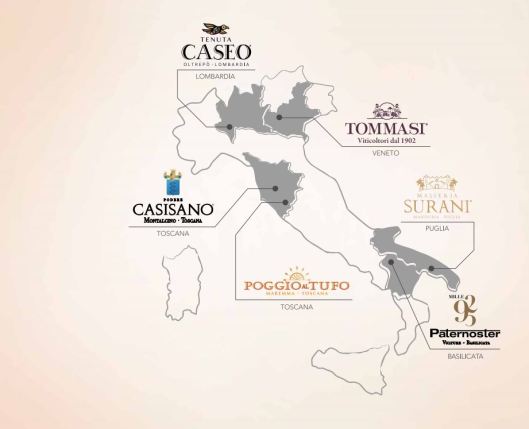
Tommasi is considered a Viticoltori, or “Viticultural Company,” which is akin to a Negociant in France. Bascially, Tommasi owns vineyards and wineries in a number of regions in Italy, four to be exact, stretching from their starting point in Verona and reaching as far east as Tuscany and as far south as Puglia. While diversification is key to a successful wine business, sometimes it can be a distraction which impacts focus and ultimately quality. Not so in the case of Tommasi. The family run organization is large enough to manage the growth and breadth of the business.

Tommasi was founded in 1902 and is situated in Pedemonte (not to be confused with Piedmont), in the heart of the Valpolicella Classico region, on a small piece of land in the Northwest part of Verona, between the plains and the Lessini mountains near Lake Garda.

Giacomo Tommasi started with a tiny vineyard in Valpolicella, and has since grown steadily over the course of many years. Today Tommasi owns vineyards and estates in four different Italian regions:
– Tommasi Viticoltori and Filodora Estate in Veneto;
– Tenuta Caseo in Oltrepò Pavese in Lombardy;
– Casisano in Montalcino and Poggio al Tufo in Maremma Tuscany;
– Masseria Surani in Manduria Puglia.

TommasiMap

The estate is run by nine, 4th generation family members all aligned with the overall mission of Tommasi – producing the most genuine Italian wines with the highest level of quality available.

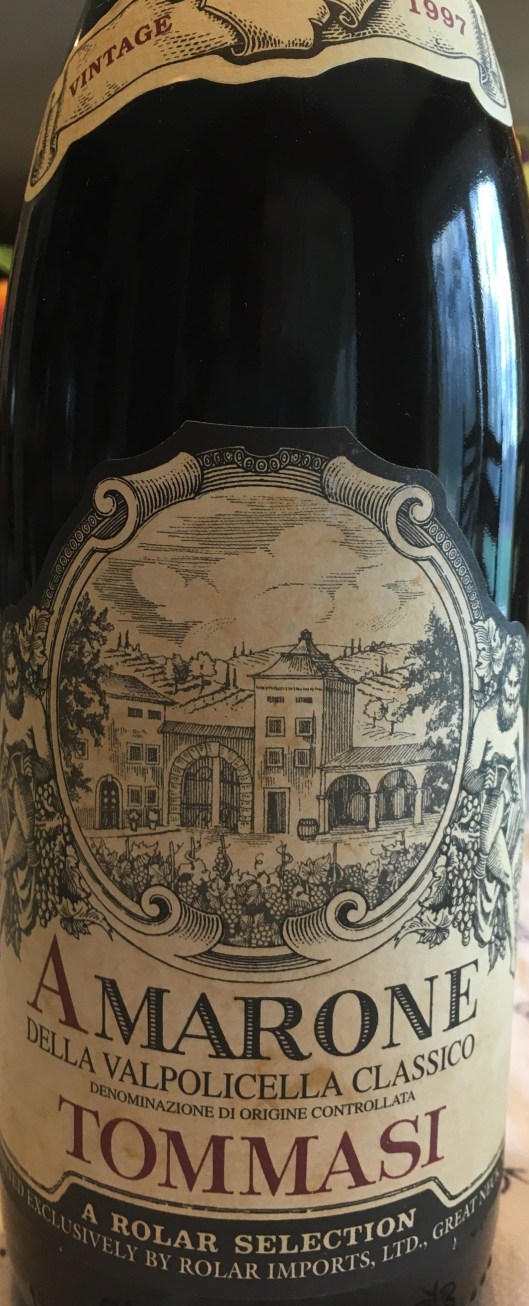
In the Veneto, Tommasi offers a very broad portfolio of wines, consisting of whites, reds, roses, sweet and even Grappa. For me, the Valpolicellas are noteworthy, especially the Amarone wines. In our cellar we have numerous vintages going back as far as 1990. Recently, we opened a 1997 Amarone and it was stunning. The wine was vibrant, full-bodied with seemingly infinite complexity. All the familiar markers of well-aged Amarone were present: dried, cooked fruit, figs, raisins with subtle black pepper and allspice notes. Prodigious length provided a stage upon which a never-ending collection of evolving flavor and aroma sensations were on display. Almost exactly 20 years old and this wine is still an explosive powerhouse. The most interesting thing to note… this bottle is Tommasi’s “entry-level” Amarone. The winery boasts a Riserva, which must truly be a remarkable wine.

TommasiAmarone

While the Amarone is the subject of my fascination here, we have their Rafaèl Valpolicella and their Ripasso bottles in our cellar, both tremendous wines in their own right.

Tommasi’s portfolio, as I noted previously is quite extensive.

Their Website is a great repository for all their wines. Of particular note is the List of Award Winning Wines – Truly impressive.

While no longer the value that it once was, Amarone is worth the expense and it appears to be an investment that improves and grows over time.


2000 Les Tourelles de Longueville

14 Friday Apr 2017

Posted by musingsonthevine in Wines

≈ Leave a comment

LesTourelles

The 2000 vintage in Bordeaux was considered an exceptional vintage. It was mildly hyped, in comparison to many other vintages like 2005, which tended to keep prices moderate. The 2000 vintage was preceded and followed by vintages that were only considered “good quality” with less aging potential. This fact worked against the moderate prices, as demand for age-worthy wines increased. For the average wine consumer, buying “second labels” afforded some relief.

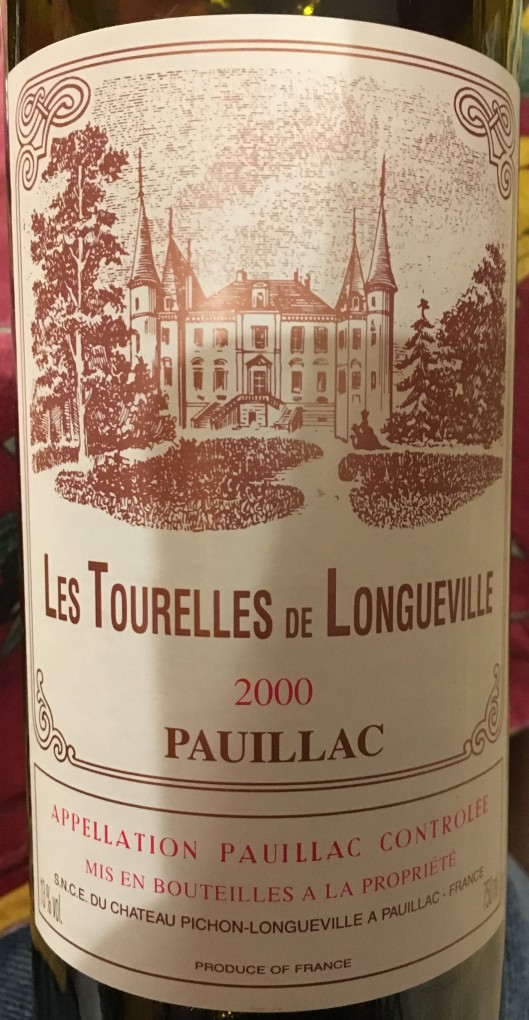
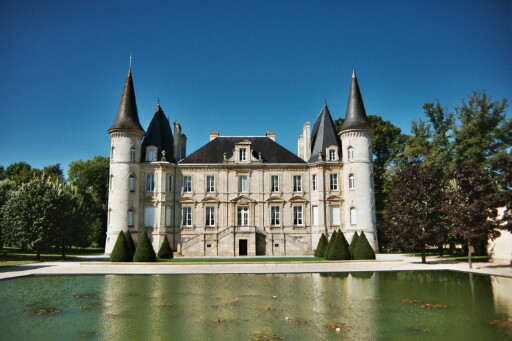
In the 2000 vintage, we purchased about twenty different producers that we felt represented good value. We employed the classic buying strategy – buy the “second labels” of noted properties. Turns out the strategy paid dividends, because among those producers purchased was the second label of Pauillac powerhouse Château Pichon Baron, known as Les Tourelles de Longueville.

Château Pichon Baron is a “second growth” wine in the famous classification of 1855. As such, the wine has extraordinary pedigree and generally produces wines of considerable structure and age-worthiness. The Château Pichon Baron website clearly states that their flagship wine “is a wine that improves year after year and can age for over 40 years in the cellar.” Age-worthy indeed.

PichonBaronEstate

Château Pichon Baron was once part of a much larger estate, owned by Pierre de Rauzan. In 1850, the estate was divided into two properties, Château Longueville au Baron de Pichon-Longueville and Château Pichon Longueville Comtesse de Lalande, or as they are commonly known: Château Pichon Baron and Château Pichon Lalande.

PichonBaronLabel
PichonLalandeLabel


Château Pichon Baron has approximately 177 acres under vine, planted with 65% Cabernet-Sauvignon, 30% Merlot, 3% Cabernet Franc and 2% Petit Verdot. The vineyard is arranged into several plots, the best of which is called the “Butte de Pichon Baron.” The average age of the vines on this plot is 30 years. Grapes are harvested and sorted by hand, and then placed in stainless steel temperature controlled vats for an extended maceration of 20-30 days. Fermentation is conducted at between 82.4°F and 89.6°F, which is considered moderate and accounts for the perfumed nature of wine’s nose. The wine is finished and aged in oak barrels.

According to the Château Pichon Baron website, the second label Les Tourelles is composed mostly of Merlot taken from the Saint Anne plot, a lesser plot than the “Butte de Pichon Baron.” No matter, in a great vintage like 2000, even the lesser plots performed admirably. The reliance on Merlot certainly accounts for the roundness and smooth, integrated flavor of the Les Tourelles. The website claims a 15 year, or more, aging window. Recently tasted at 17 years and the wine is going strong. Although it tastes like the wine may have levelled off in terms of potential improvement, the wine possesses enough density and structure to continue to hold for many more years.

So, a look at the numbers… Château Pichon Baron was released in 2003 at approximately $100/bottle. Wine Spectator rated the wine at 93 points. Today, the wine can be found in many outlets in the US and it carries an average price of $264/bottle (164% increase). The wine was re-tasted by Wine Spectator in 2016 and scored a 94. Slightly improved.

Les Tourelles was also released in 2003 at approximately $20/bottle (we paid $24.64/bottle). Wine Spectator rated the wine at 88 points. Today, the wine can only be found in Trenton, NJ at $80/bottle (224% increase from our cost). The wine was never re-tasted by Wine Spectator, but our recent taste confirms that it is holding fast.

Looking at the numbers and judging by our most recent sample, I’m really glad we bought the case of Les Tourelles when we did. Now, while you can’t get the 2000 Les Tourelles anymore, unless you happen to have healthy disposable income and are convenient to Trenton, the moral of the story proves that the “second label” buying strategy in great vintages is sound and should be heeded. Why is this important? Because recent vintages in Bordeaux ARE available and the hype and prices are not getting any better… So buying second labels is an effective way of bringing great, age-worthy wine into the cellar without completely ruining the budget.


Argiolas

11 Tuesday Apr 2017

Posted by musingsonthevine in Wines

≈ Leave a comment


It was over 30 years ago when I first tasted Sardinian wines. The wine maker had traveled to the US to promote his wines, which at the time were almost unknown. He had contacted small tasting groups in the area and literally came into my friend’s house to offer his wines. It was my first exposure to the island wines of Sardinia and one that I have never forgotten. The wines were unique and tasted like nothing I had drank up to that point. Not to say that I had much in the way of “global” wine experience back then, but the wines all had a refreshing and vibrant character, reflective of the sunny climate of the islands. Today, Sardinian wines are much more prevalent, almost mainstream. Although, the grape names can be confusing and many are only grown in Sardinia, which proves a challenge to sell. Despite the challenge, many restaurants and wine shops are doing their level best to introduce us all to the magical wines of Sardinia.


One producer that is making a big splash is Argiolas (http://www.argiolas.it/en/index.html), a family-owned winery that was started in the early 1900’s in the commune of Serdiana in southern Sardinia. The commune is roughly 12 miles north of the capital city of Cagliari. Here in Sedriana the Argiolas family owns several vineyard parcels, planted with mostly traditional Sardinian varietals. The family also owns vineyards in adjoining communes, Parteolla, Siurgus, Selegas and Guamaggiore. Overall, Argiolas has over 500 acres under vine in some of the most prized areas of Sardinia. The variety of soil, climate and elevation of their many properties gives them an opportunity to truly showcase the many indigenous grapes known only to Sardinia.


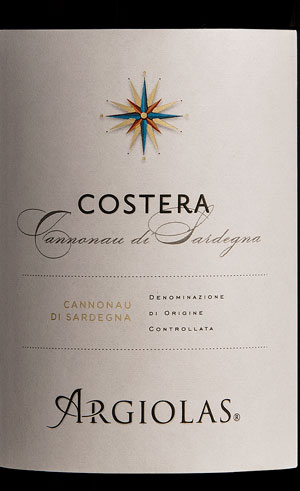
Two wines of note that I have enjoyed recently are the Costera and the Perdera, both wines in the Argiolas Tradition, or “mid-priced” category.

Argiolas-costera_et


The Costera is a Cannonau di Sardegna (DOC) wine. The varietal is Cannonau, or Grenache as it is known in France and was brought by the Romans to Sardinia from Spain. The grapes are sourced from several vineyards, with the predominant soil having limestone, and clay elements, with a medium, loose mixture of small and medium-sized stones and pebbles. The climate is predominantly Mediterranean, with mild winters, limited rainfall, and very hot and windy summers. The wine is produced in a state-of-the-art facility employing temperature controlled primary fermentation, lasting about 12 days following maceration. Full malolactic is employed to soften the acids and the wine is then aged in small oak cooperage for up to 10 months. The wine is unfiltered, but mildly fined to remove some sediment. The wine itself has a bright, ruby and garnet color with a lively, spicy nose. On the palate, the wine exhibits red fruit notes with moderate tannin and acid providing good structure and balance. Not intended for long-term aging, the wine is drinking very well, although some bottle age will integrate the tannins.


Argiolas-perdera_et

The Perdera is a Monica di Sardegna (DOC) wine. Monica is a red grape that is almost solely grown in Sardinia. Like Cannanau, the grape originated in Spain, but it is no longer grown there. The grapes are sourced from several vineyards, again with limestone and clay structure and loose gravel top soil. The climate is Mediterranean, again with very limited rainfall, only averaging about 21 inches per year. Like the Costera, fermentation is temperature controlled, lasting about 10 days allowing a moderate extraction of tannin and pigment. The wine is again unfiltered and is aged in small oak cooperage for up to 8 months. The wine has a bright, ruby complexion with dark undertones and a spicy, lightly jammy nose. On the palate, the wine exhibits cherry and berry fruit with a hint of “sweetness.” The wine is structured, but possesses roundness with a smooth finish. Not intended for long-term again and drinking nicely.

← Older posts
Newer posts →

Subscribe

  • Entries (RSS)
  • Comments (RSS)

Archives

  • June 2020
  • May 2020
  • April 2020
  • March 2020
  • February 2020
  • January 2020
  • December 2019
  • August 2019
  • February 2019
  • December 2018
  • November 2018
  • October 2018
  • September 2018
  • August 2018
  • July 2018
  • June 2018
  • May 2018
  • April 2018
  • March 2018
  • February 2018
  • January 2018
  • November 2017
  • August 2017
  • July 2017
  • June 2017
  • April 2017
  • March 2017
  • February 2017
  • January 2017
  • December 2015
  • October 2015
  • August 2015
  • July 2015
  • June 2015
  • December 2014
  • November 2014
  • August 2014
  • July 2014
  • June 2014
  • May 2014
  • April 2014
  • March 2014
  • February 2014
  • January 2014
  • December 2013
  • November 2013
  • October 2013
  • September 2013
  • August 2013
  • July 2013
  • June 2013
  • May 2013
  • April 2013
  • March 2013
  • February 2013
  • January 2013
  • December 2012
  • September 2012
  • August 2012
  • July 2012
  • June 2012
  • May 2012
  • April 2012
  • March 2012
  • February 2012
  • January 2012
  • December 2011
  • November 2011
  • October 2011

Categories

  • Cocktails
  • General
  • Restaurants
  • Spirits
  • Uncategorized
  • Wine Events
  • Wines

Meta

  • Create account
  • Log in

Blog at WordPress.com.

  • Subscribe Subscribed
    • blog.musingsonthevine.com
    • Join 36 other subscribers
    • Already have a WordPress.com account? Log in now.
    • blog.musingsonthevine.com
    • Subscribe Subscribed
    • Sign up
    • Log in
    • Report this content
    • View site in Reader
    • Manage subscriptions
    • Collapse this bar
 

Loading Comments...