Category Archives: Wines

2009 Château de Lascaux, Côteaux du Languedoc

20 Sunday Nov 2011

Posted by musingsonthevine in Wines

≈ Leave a comment

Lascaux is the site of some of the oldest and best preserved Paleolithic cave paintings, dating back over 17,300 years. In my History of France in Ten Glasses class, Lascaux is where it all starts and we usually serve up something from Côteaux du Languedoc, or sometimes Provence. The caves contain well over 2,000 figures, which have been categorized as animal, human and abstract runic signs. The animals represent large species that have been identified primarily from fossilized remains. The site is a fascinating look into our ancestry and the incredible poise that these ancient peoples possessed.

A little while back I wrote about “one that got away…,” referring to a 2007 Château de Lascaux that was simply joyous. Well, in working through the last group of wines reconstructing the Harvard Faculty Club list, I tasted the 2009 vintage from this producer. Like most of what I’ve tasted from 2009, the wine was chock-full of fruit. Where the 2007 had presence, structure and focus, the 2009 has panache, drinkability and gregariousness. The 2009 is primarily Syrah (60%), with Grenache (30%) and Mourvedre (10)% as helpmates. At an average retail price of $15.99 per bottle, this is another nice find. By the way, the artwork on the label is a representation of some one of the cave paintings in Lascaux.

My tasting note:

Ripe, dense nose with blueberry, cherry, tar and dried herb hints. Full-bodied with moderate acidity and dry, well-integrated tannin – good balance. Peppery with black cherry and blackberry jam on the palate. Violets, rosemary and white pepper notes abound. Smooth and enticing. Moderate length – young. Drinking well now and should hold for another 2 to 3 years in the bottle. A good value.

Cheers!

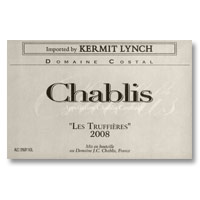
2008 Domaine Costal Les Truffières, Chablis

15 Tuesday Nov 2011

Posted by musingsonthevine in Wines

≈ Leave a comment

For generations of American wine drinkers, the term Chablis means insipid, slightly sweet white wine that comes from the Central Valley of California. As a wine educator, this is painful, but I can’t blame the wine drinking populace. No, I level the blame with the ATF, and now the TTB, the organizations responsible for promulgating the wine labeling requirements for wine in the US. Many years ago, in their infinite wisdom, the ATF decided to create a set of “generic terms” that could be used on wine labels to help “name” and “market” wines made in the US. Chablis is one such term and it is unfortunate, especially since the French have sought legal protection for most of their more famous AOC’s.

What I want folks to understand is that official French Chablis is Chardonnay in its purest form. Irrigation other than the moisture Mother Nature provides is illegal for AOC wines. This means that the vines in most French vineyards grow deep into the sub-soil searching for precious water. The depth of these root systems allows the vine to take up a lot of complex minerality from the soil. In the case of Chablis the sub-soil is prehistoric sea shells, which produce a distinctly chalky note. Arguably this is one reason that Chablis is the near-perfect accompaniment to oysters…

The Domaine Costal, another partnership involving Kermit Lynch is stunning Chablis. The other stunning factor is the price – average retail of $29.99 per bottle is a remarkable value. If you prefer your Chardonnay as an expression of the fruit and not winemaking techniques, then this is a wine for you!

My tasting note:

Green apple and mineral nose – clean with just a tiny hint of oak. Medium-bodied with moderate acidity – rich – well balanced. Tart, citrus palate with lemon, apple and pear notes. Long finish with a purity of fruit – delightful! Drinking well now and should improve with another 5 to 7 years in bottle. A good value in Chablis!

Cheers!

2010 Torres Viña Esmeralda, Cataluña, Spain

14 Monday Nov 2011

Posted by musingsonthevine in Wines

≈ 1 Comment

In my History of Italy, France and Spain in Ten Glasses classes I talk about the important contributions that the Muslims made to the history of wine and spirits. For openers, the Muslim invaders brought with them the art and science of distillation, which they used for producing perfumes and medicinal elixirs. It took distillation in the hands of Christian monks to produce a different elixir, one known as the “water of life,” or Whisky. Muslims also brought with them a better understanding of astronomy and the impact of planetary motion on agriculture, which in turn improved the growing of crops, especially grapes. Lastly, the Muslims brought with them the vine – specifically vines of the Muscat grape. Despite the conflict that has raged between Christians, Jews and Muslims over the last 2,000+ years, I think we wine and spirits lovers should take a moment to say thanks.

So I’m not waxing poet about world peace, but I am going to rave about a lovely wine from Spain – the 2010 Torres Viña Esmeralda, a terrific blend of Muscat (85%) and Gewurztraminer (15%), giving the wine an exceptionally exotic nose and palate. A “light” wine at 11.5% alcohol (I seem to recall when a “light” wine contained 5% – 7% alcohol), the forward fruit provides the teasing impression of sweetness, but the finish is crisp and food-friendly. At an average retail price of $13.99 per bottle, you really can’t go wrong.

My tasting note:

Perfumed, floral nose with honeysuckle, lychee and pear hints – gorgeous! Light-bodied with moderate acidity – crisp and clean – well balanced. Citrus and exotic fruit palate – lemon, apricot and papaya notes – smooth. Moderate length – light and refreshing. Drinking well – not for aging, although the screw cap will keep the wine fresh for a while.

Perfect for the Thanksgiving table!

Cheers!

2007 Tolaini Valdisanti, Toscana

11 Friday Nov 2011

Posted by musingsonthevine in Wines

≈ 1 Comment

Super Tuscan… Most people who have drunk wine long enough know the term… For those who don’t, the term was coined back in the late 70’s, early 80’s and it describes a particular type of wine from Italy’s Tuscany region – the home of one of the world’s most well – known wines – Chianti. So where does this term come from? Well, as I have related to so many of my classes, throughout the 60’s and early 70’s the wines of Chianti were universally considered some of the most awful wine on the planet. Rampant over planting and production, combined with less-than-stellar wine making combined to produce wine that was thin, bitter and just dreadful. Even pizza was embarrassed to have to share the limelight with this inferior plonk.

With time, younger wine makers, and a few traditionalists started a movement to make Chianti a wine worthy of its name. However, during this renaissance of wine, certain producers felt that the problem was more deeply-rooted – fundamentally the laws governing production in Chianti needed to be “updated” to harness the true potential of wine making in the region. Well, updating wine laws in Italy is tantamount to changing the laws of Roman Catholicism – I think it involves flying pigs, or a certain subterranean region freezing over… Get the picture? So, a few enterprising folks decided to make some wine that was truly the best wine they could make, literally “Super Tuscan” wine. Of course, the wine did not conform to wine law standards and therefore had to be delimited as plain old Vino da Tavola wine, but to wine connoisseurs around the globe, these were wines worth noticing.

The bottles commanded extraordinary prices, which were shocking for wines that were no more than “table wines,” but the quality and character of the wines spoke volumes about what these wines were really worth. Over time the wine laws would adapt to recognize these wines for what they are – non-traditional Italian wines of the highest quality. Eventually the term Indicazione Geografica Typica Toscana would supplant the term Vino da Tavola, and a new hot region was born…

In Europe vintages are much more important than they are in the US. Where California basks in near perfect growing conditions, Europe almost always has to light candles for Mother Nature to shine a little beneficial sunshine on their oft suffering vineyards. Lately, though Europe has enjoyed a few really terrific vintages – 2005, 2007 and now 2009. I have tasted a lot of wine from all three vintages and they are each distinct. The 2005 vintage is big – wines with lots of fruit and lots of tannin – near endless aging potential… The 2007 vintage produced wines with good structure and balance, but unlike 2005, the 2007 wines tasted a bit more integrated and mature. The 2009 vintage is like 2005 on steroids – bigger, fuller in-your-face wines that seem endless…
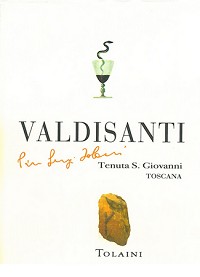
Here we have a really fantastic wine – from the 2007 vintage the wine has a smoothness and maturity that is welcoming. The region is Toscana and you can tell that while Sangiovese plays a part in the wine, the dominant grapes are non-indigenous varietals – Cabernet Sauvignon and Cabernet Franc… A Parker 90+ wine, which I could care less about, but some folks will take as validation – small quantities and somewhat expensive – $29.99 average retail per bottle – high value in my book…

 My tasting note:

Ripe, jammy nose with blackberry, raspberry, lilac and tar hints – stunning. Full-bodied with moderate acidity and firm, dry tannin – good balance. Sour cherry palate with truffle, saddle and red berry notes – impressive. Long finish – smooth with layers of complexity – spice, cocoa and vanilla bean. Drinking well and should improve with 7 to 10 years in the bottle. Good value.

Here’s to breaking the rules and producing the best wine possible!

Cheers!


2010 Elk Cove Vineyards Pinot Gris, Willamette Valley

11 Friday Nov 2011

Posted by musingsonthevine in Wines

≈ Leave a comment

As far as grapes go, Pinot Gris has a pretty tough life… As Pinot Grigio, this grape has contributed to millions of gallons of insipid and watery Italian white wine that frankly has less character than the Aqua Minerale perched next to your order of Bruschetta. Thankfully this is changing and producers like Alois Lageder are proving that Pinto Grigio can make respectable wine. Across the Alps into France the grape fairs better, but is often beaten out by the competition – Pinot Blanc, Riesling and the ever exotic Gewurztraminer. The racy acidity that is often a hallmark of well-made Pinot Gris is underappreciated when put beside the alluring characters of its brethren. Domestically, Pinot Gris is often lost in a sea of buttery Chardonnay, competing like a plain-Jane wall flower at the High School prom against the likes of Pamela Anderson during her best Bay Watch years.

Thankfully, winemakers in the Pacific Northwest have found that the growing conditions are a perfect match for producing wonderful Pinot Gris and the folks at Elk Cove Vineyards are masters with the grape. Expressive, beautiful with a pleasingly crisp palate – what more could one ask for in a wine? At an average retail price of $19.99 per bottle it may not be the cheapest wine on the shelf, but it sings “value wine.”

My tasting note:

Bright, lively nose with citrus, floral and mineral hints – lovely and seductive. Medium-bodied with racy acidity – crisp and clean – very well-balanced. Tart, mouthwatering with good mid-palate fruit – lemony with subtle pear and green apple notes. Moderate length with a pleasant, lingering finish. Drinking well now – not for aging, but the screw cap closure will ensure some longevity.

Cheers!

2009 Château Veyrin, Listrac-Médoc

10 Thursday Nov 2011

Posted by musingsonthevine in Wines

≈ Leave a comment

At the Smart Wine Shopping event at Martignetti’s we tasted through a number of really nice wines, all positioned as high-value – meaning not necessarily cheap, but certainly worthy of spending your hard-earned wine dollars to acquire… One wine of note is a tasty little gem from Bordeaux, produced in the modest commune of Listrac-Médoc. Not as famous as some of the other communes along the left bank, Listrac-Médoc can produce, in great vintages, wines that deserve attention. The other nice aspect of Listrac-Médoc is that its modest stature means modest prices, usually.

The 2009 Château Veyrin is virtually unknown, at least to me anyway, but I’m less about notoriety and more about what’s in the bottle. And there is quite a bit in this bottle. Plumy, chewy with nice structure make this wine a real winner, especially at an average retail of $17.99, pre-discount.

My tasting note:

Fresh cherry fruit nose with characteristic mineral, tobacco leaf and mint hints. Medium-to-full-bodied with moderate acidity and moderate tannin – good balance. Black currant palate with menthol and plum notes. Moderate length with a tight finish. Drinking well and should improve with another 3 to 5 years in the bottle. Super value in a stellar vintage.

Cheers!

2009 Cypress Cuvée (Blended by Kermit Lynch), Côtes du Rhône

09 Wednesday Nov 2011

Posted by musingsonthevine in Wines

≈ Leave a comment

I told you so… 2009 is stacking up to be one of those vintages where everything I put in my mouth is just sensational. In 2000, when the 1998 Southern Rhone wines came to market, we bought over 65 cases of Chateauneuf du Pape alone. We can’t do that again without buying another house to store all the wine in… We can’t do that again… Hmmm…

Kermit Lynch is known by many to be one the ground-breaking negociant/importers that specializes in small, out of the way producers that make terrific wines. That was many decades ago and now his fame lends itself to “private” label wines of his own creation. With the 2009 Cypress Cuvée, Mr. Lynch did alright… especially at an average retail cost of $15.99…

My tasting note:

Youthful, earthy nose with fresh cherry, strawberry and truffle hints. Medium-to-full-bodied with moderate acidity and firm, dry tannin. Good balance. Lush palate with blackberry, cacao and gamey notes – classic CDR. Long finish with spice and dried fruit notes – like a Vino Ripasso! Drinking well and should easily improve for another 5 to 7 years in the bottle. Great value!

The Kermit Lynch web site states the 2009 vintage is 80% Syrah and 20% Grenache, clearly verified by the structure and spicy notes. I don’t have production numbers, but I would not dawdle – wine this good will not last long!

Cheers!

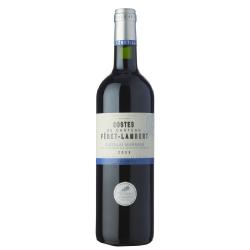
2009 Costes du Château Féret-Lambert, Bordeaux Supérieur

08 Tuesday Nov 2011

Posted by musingsonthevine in Wines

≈ 3 Comments

I have always told my classes that in highly-touted Bordeaux vintages, such as 2000, 2005 and now 2009, often times the best place to look for top quality wines at modest prices is in the lesser properties, or second labels of classified wines. Bordeaux has become such an expensive commodity that finding affordable, classified wines is no longer an option for most buyers. This is especially true in recent vintages. So, when a wine like the Costes du Château Féret-Lambert shows up, I take notice.

I tasted this wine as a part of the selection process for redeveloping the Harvard Faculty Club wine list and the wine is, in a word: stupendous. At an average retail somewhere around $15.00, this wine is off the charts. Primarily Merlot (90%), as you would expect from the AOC, the property states soil types of clay, limestone and fossilized coral, which certainly comes through on the palate. Moderate oak aging and progressive wine making techniques have combined to produce a real star.

My tasting note:

Lush, black currant nose with jammy, mineral and cedar hints. Medium-to-full-bodied with moderate acidity and firm, structured tannin – great balance. Dark fruit core with black cherry, bittersweet chocolate and tar notes. Wow! Moderate length with a super smooth finish. Drinking well now and should continue to improve in bottle for another 5 to 7 years, perhaps more. Simply a superb value.

So my advice – although 40,000 cases were made, I would run to my local purveyor and take home at least a case. Cheers!


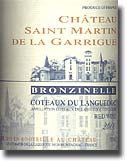
2009 Chateau Saint Martin de la Garrigue – Bronzinelle

06 Sunday Nov 2011

Posted by musingsonthevine in Wines

≈ Leave a comment

I have a feeling that I am going to be posting a lot about European wines from the 2009 vintage… So far, 2009 is reminiscent of other vintages like 1997, 1998, 2000, 2005 and 2007…

I picked up several wines the other day and gave one a try – Chateau Saint Martin de la Garrigue Bronzinelle, from Coteaux de Languedoc. What a gem! The wine is structured and delicious – my note follows:

Lively nose with black raspberry, fresh cherry and dried herb hints. Full-bodied with moderate acidity and firm, chewy tannin – great balance. Dark fruit core with spice, cedar and cacao notes. Moderate length with a tight, layered finish. Drinking well and should continue to  evolve and improve for another 5 to 7 years in bottle. Great value.

At $15.99 (average retail, pre-discount) per bottle, this is a  real charmer – true, past vintages of this wine were closer to $10.00, but at the current price, the wine still represents a magnificent value. The wine should have wide availability.


Every so often one gets by…

16 Sunday Oct 2011

Posted by musingsonthevine in Wines

≈ Leave a comment

I’ve been enjoying the 2009 wines from Europe, mostly France and loving the richness and depth of flavors. Some 2010 wines have tickled my fancy, but there are many more of those arriving over the next year, or so… And then, sometimes an “older” vintage shows up and, wham! You remember how great certain past vintages are. Take 2007 – a stellar vintage in Europe, especially in France and Italy… I was tasting some wines for possible addition to Harvard Faculty Club’s wine list and came across this gem:

2007 Chateau de Lascaux Coteaux de Languedoc ($14.99 approximate retail)

Dense, earthy nose with black cherry, cocoa and dried herb hints. Full-bodied with moderate acidity and supple tannin – good balance. Cherry, blackberry jam and black currant palate – youthful with mint and licorice notes. Long finish – smooth – tight, showing a nice layered complexity. Drinking well now – should continue to hold for the next 3 to 5 years. Good value.

(I picked up a case at Martignetti’s in Brighton – the current vintage at most shops is 2008)


← Older posts
Newer posts →

Subscribe

  • Entries (RSS)
  • Comments (RSS)

Archives

  • June 2020
  • May 2020
  • April 2020
  • March 2020
  • February 2020
  • January 2020
  • December 2019
  • August 2019
  • February 2019
  • December 2018
  • November 2018
  • October 2018
  • September 2018
  • August 2018
  • July 2018
  • June 2018
  • May 2018
  • April 2018
  • March 2018
  • February 2018
  • January 2018
  • November 2017
  • August 2017
  • July 2017
  • June 2017
  • April 2017
  • March 2017
  • February 2017
  • January 2017
  • December 2015
  • October 2015
  • August 2015
  • July 2015
  • June 2015
  • December 2014
  • November 2014
  • August 2014
  • July 2014
  • June 2014
  • May 2014
  • April 2014
  • March 2014
  • February 2014
  • January 2014
  • December 2013
  • November 2013
  • October 2013
  • September 2013
  • August 2013
  • July 2013
  • June 2013
  • May 2013
  • April 2013
  • March 2013
  • February 2013
  • January 2013
  • December 2012
  • September 2012
  • August 2012
  • July 2012
  • June 2012
  • May 2012
  • April 2012
  • March 2012
  • February 2012
  • January 2012
  • December 2011
  • November 2011
  • October 2011

Categories

  • Cocktails
  • General
  • Restaurants
  • Spirits
  • Uncategorized
  • Wine Events
  • Wines

Meta

  • Create account
  • Log in

Blog at WordPress.com.

  • Subscribe Subscribed
    • blog.musingsonthevine.com
    • Join 36 other subscribers
    • Already have a WordPress.com account? Log in now.
    • blog.musingsonthevine.com
    • Subscribe Subscribed
    • Sign up
    • Log in
    • Report this content
    • View site in Reader
    • Manage subscriptions
    • Collapse this bar
 

Loading Comments...